
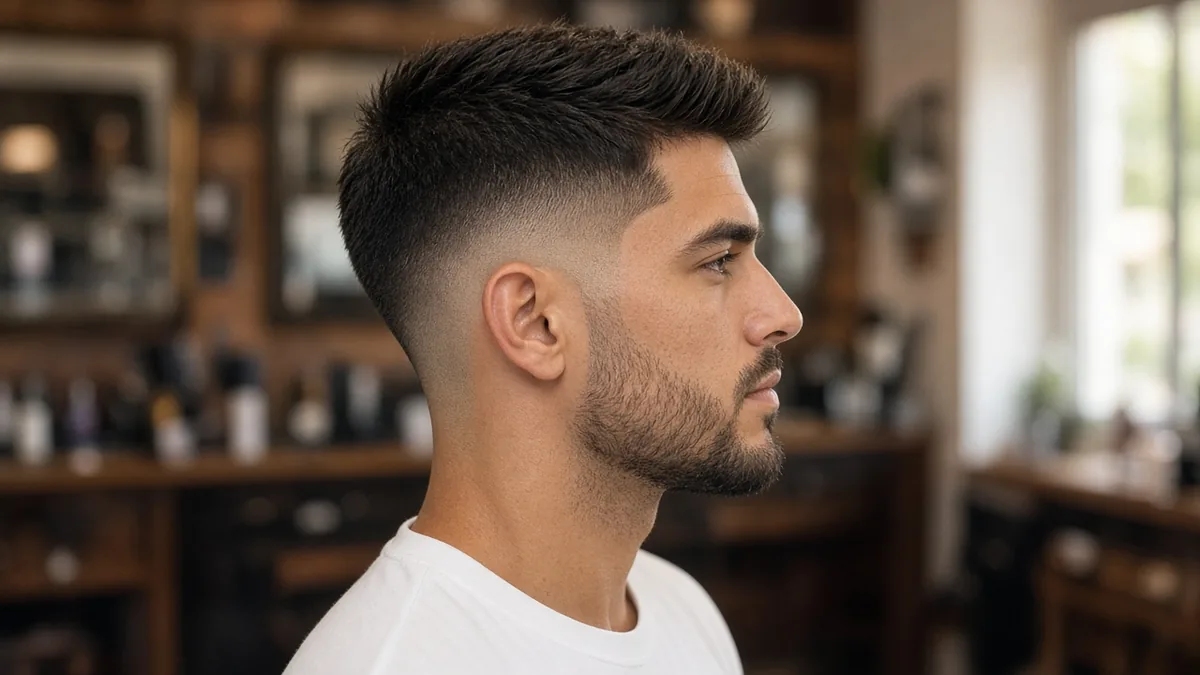
A mid fade is a haircut where the sides and back go from very short at the bottom to longer hair on top, with the blend starting at roughly temple height. Low fades sit down by the ear. High fades climb toward the crown. The mid fade lives in between, and that’s exactly why it’s the one most guys end up asking for.
The catch is that “mid” isn’t a measurement. Ask three barbers to place it and you’ll get three slightly different lines.
So if you’ve ever walked out with a fade that looked higher (or lower) than the photo you showed, that’s usually why. The fix is to stop relying on the name and start describing the cut with landmarks on your own head and a couple of guard numbers.
What counts as a mid fade
Every fade has a bottom, a blend and a top. The bottom is the shortest point near the ear and neckline, anything from bare skin to a #1 guard. The blend is the gradient where the length climbs. The top is whatever you’ve kept up there to style.
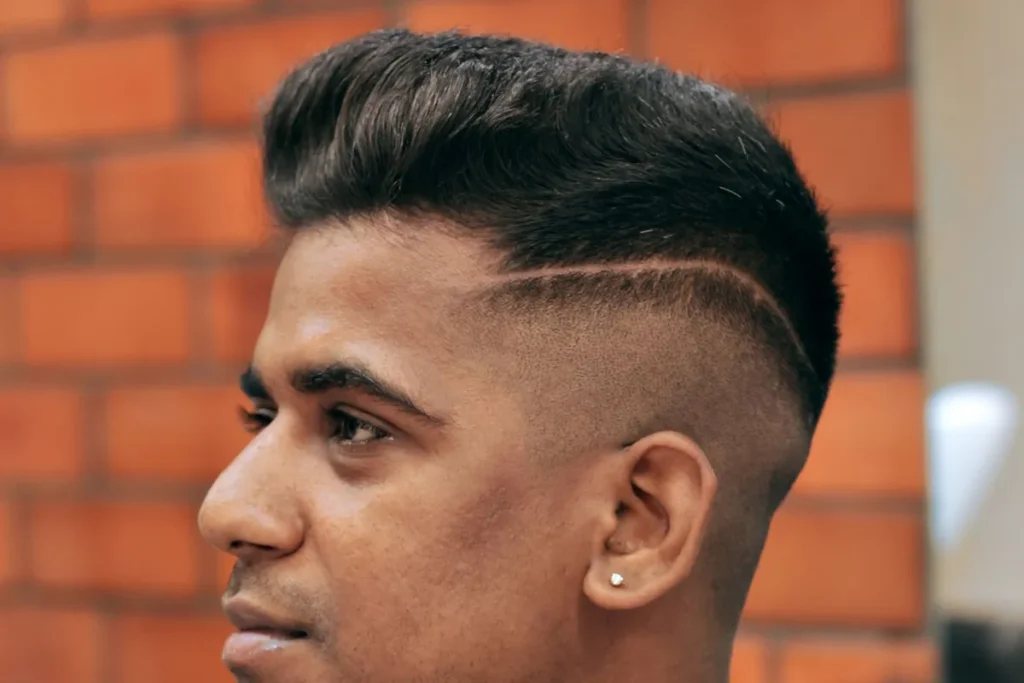
What makes it a mid fade is where that blend tops out. Barbers read the head like a map. On the sides, the line usually runs at or just below the temple recession, a few centimeters above the top of the ear. Round the back, it meets at or slightly under the occipital bone, the bump you can feel at the back of your skull.
Want a quick mirror test? Picture a line running straight back from the outer end of your eyebrow. A mid fade starts around there. If the short part stops at the top of your ear, that’s low. If it’s creeping up toward the corners of your forehead, you’re in high fade territory.
Low, mid or high fade?
Height changes the whole personality of the cut. This is how the three compare in practice.

| Low fade | Mid fade | High fade | |
|---|---|---|---|
| Where the blend starts | Just above the ear and neckline | Around the temples | Near the crown or forehead corners |
| How much scalp shows | Very little | A moderate band | A lot |
| How it reads | Quiet, conservative | Clean and balanced | Loud, high-contrast |
| How it grows out | Most forgiving | Middle of the road | Looks untidy fastest |
If you’re on the fence, go mid. I’d say that to almost anyone getting their first fade, because you can always take it higher next visit. Going lower means waiting for hair to grow back, and that takes weeks.
Mid fade, mid taper, drop and burst
These names get mixed up constantly, and it’s the single biggest source of “that’s not what I asked for” moments in a barbershop.
A mid taper only shortens the hair at the edges, meaning the sideburns and the nape. The sides above that keep visible length. It’s softer, it grows out more gracefully, and it’s the one I’d pick if your workplace is fussy about visible scalp.
A mid drop fade starts at mid height on the sides, then curves down behind the ear toward the nape instead of running straight round the head. It follows the shape of the skull and leaves more weight at the back, which is why barbers love it on curly and coily hair.
A burst fade fades in a half-moon around the ear and leaves the back longer. You’ll mostly see it under mohawks and curly tops.
Then there’s the finish at the bottom, which has nothing to do with height. A mid skin fade takes the bottom right down to bare skin with a foil shaver or razor. A mid shadow fade stops at a #0.5 or #1, so you can still see a faint shadow of hair. Skin looks sharper on day one. Shadow is kinder to sensitive skin and hides regrowth for longer.

Guard numbers, so you can speak barber
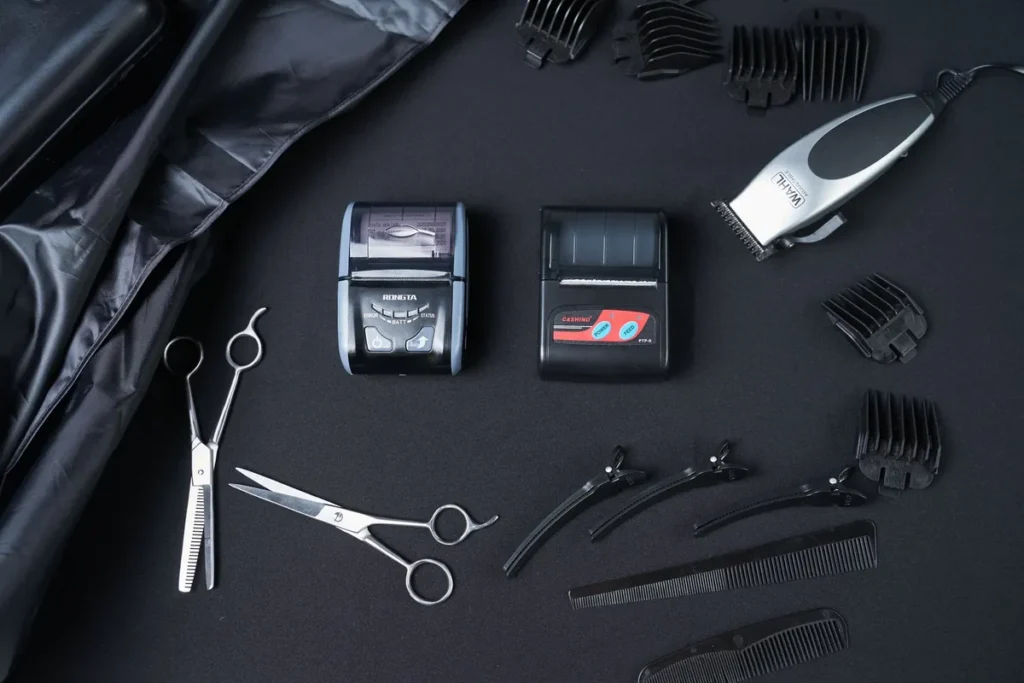
Most fades are built with clipper guards and then blended by hand. These lengths come from Wahl’s guide comb chart. Other brands are close, but not always identical.
| Guard | Length it leaves | Typical job in a mid fade |
|---|---|---|
| No guard / foil | Skin | Bottom of a skin fade |
| #0.5 | 1/16 in (about 1.5 mm) | Bottom of a shadow fade |
| #1 | 1/8 in (3 mm) | Lower blend |
| #1.5 | 3/16 in (about 4.5 mm) | Softening the first line |
| #2 | 1/4 in (6 mm) | Middle of the blend |
| #3 | 3/8 in (10 mm) | Upper blend near the temple |
| #4 and up | 1/2 in (13 mm) or more | Where the fade meets the top |
A common recipe runs skin or #0.5 at the bottom, #1 and #2 through the middle, and a #3 or #4 into the top. Your barber will tweak it. Thick dark hair shows every guard step, so it needs more hand-blending. Fine or fair hair is far more forgiving.
You will also hear fades named by their guards, for example a “1-2-3 fade” or a “2-3-4 fade”, meaning those guards are used from the bottom up. Detachable clipper blades are numbered the other way round from guards: on those, more zeros means closer, so a 000 blade cuts shorter than a 0. If your barber mentions a blade rather than a guard, ask what length it leaves.
Two numbers will get you further than any description. “Skin at the bottom, about two inches on top” leaves much less room for guesswork than “short on the sides, please.”
Does a mid fade suit you?
For most people, yes. It’s the safest fade height for the widest range of heads. A few things do change how it lands, though.
Face shape matters mostly through the top, not the fade itself. Round faces do well with some height up there, like a quiff or a textured crop, and tight sides so nothing adds width. Square jaws suit the clean lines of almost any mid fade. Long faces are the one case where I’d hold back on height; a shorter crop or a forward fringe keeps things in proportion, and some guys with long faces are happier with a low fade.
Hair type matters more than people expect. Straight hair shows the gradient very clearly, so you want a barber who blends well. Wavy hair often behaves better once a fade takes the bulk off the sides, and if your waves sit in the 2b to 2c range, our 2c hair guide covers how to get definition up top without frizz.
Curly and coily hair is where a mid fade really shines. The tight sides give the curls on top a frame, and a drop or burst fade adds shape at the back.
And if you’re thinning on top, mid or low is usually the kinder choice. A very high fade puts a spotlight on the crown.

Skin fades and razor bumps
This is the bit most style roundups skip, and it matters most for men with curly or coily hair.
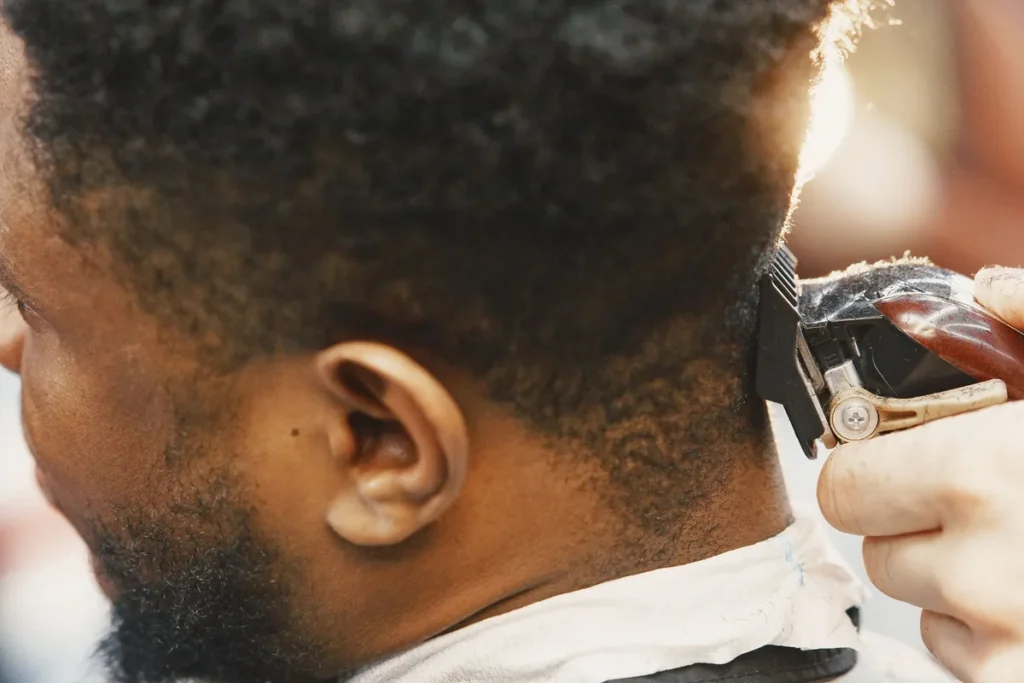
When curly hair is cut right down to the skin, the regrowing hair can curl back and pierce the skin. That’s pseudofolliculitis barbae, better known as razor bumps. A 2019 review of treatment options notes that electric clippers are linked with fewer bumps than close shaving, on the face and on the scalp, and recommends leaving at least 1 mm of hair.
In practice, if skin fades leave you bumpy, switch to a shadow fade with a #0.5 or #1 at the bottom and ask your barber to skip the foil shaver at the nape. You’ll lose a little sharpness.
Firm bumps at the back of the neck that don’t go away, or that start to scar, are a different story. That can be acne keloidalis nuchae, and the American Academy of Dermatology says frequent close-shave haircuts on the back of the neck and head can make it flare. It advises avoiding haircuts that shave those areas. If you’re seeing scarring or patches where hair has stopped growing, that’s a dermatologist appointment, not a barber one.
The tops that work best with a mid fade
The fade is only half the haircut. What you do on top decides whether it reads modern, classic or sporty.
1. Textured crop
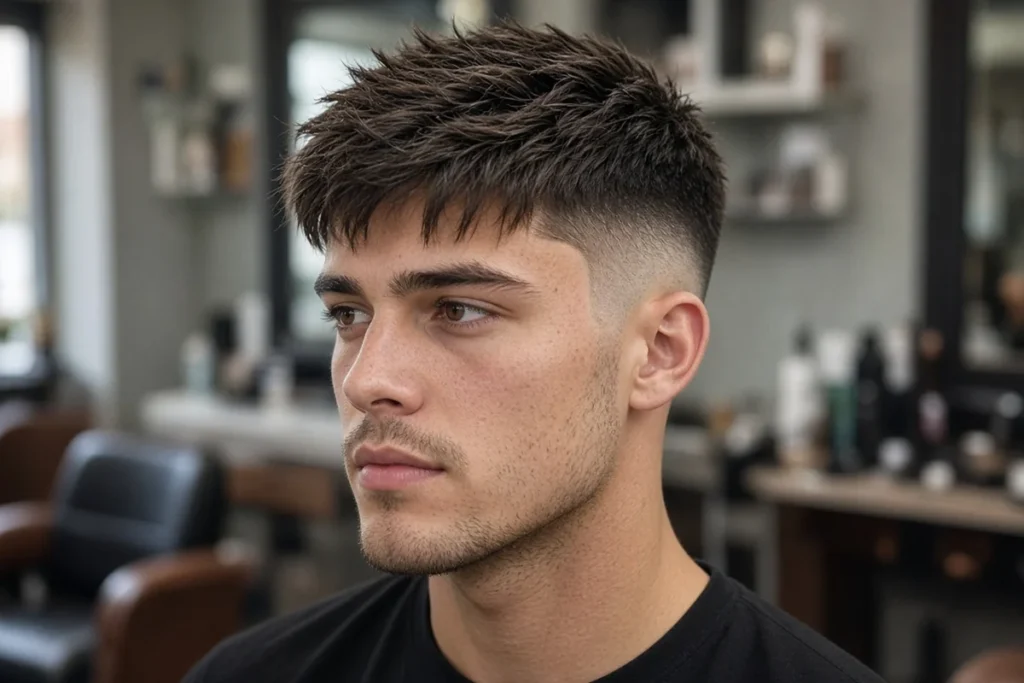
The textured crop is the most requested version for a reason. You keep one to three inches on top, the barber chops texture in with point cutting, and the fringe sits forward. A pea-sized amount of matte clay and you’re done in two minutes. A French crop is its tidier cousin with a blunt, straight fringe, and it’s a good move if your forehead is on the high side. If you’d rather keep real length up top and hide the short sides altogether, a two block haircut is the softer alternative.
2. Quiff or pompadour
For more height, keep three to five inches for a quiff or pompadour. You’ll need a blow-dryer and a medium-hold product, and you’ll need to actually use them every morning. Be honest with yourself before you commit.
3. Side part or slick back
For the office, a side part or slick back over a mid fade still looks sharp. Ask your barber to leave a touch more length where the fade meets the top so the part has something to sit against.

4. Comb-over with a hard part
A comb-over is the side part’s sharper cousin. The top is cut a little longer, two to four inches, and combed across to one side, and many barbers razor a thin hard part along the line where it splits. It looks neat in photos and at work, but the shaved part grows out within a couple of weeks, so skip it if you cannot book often.
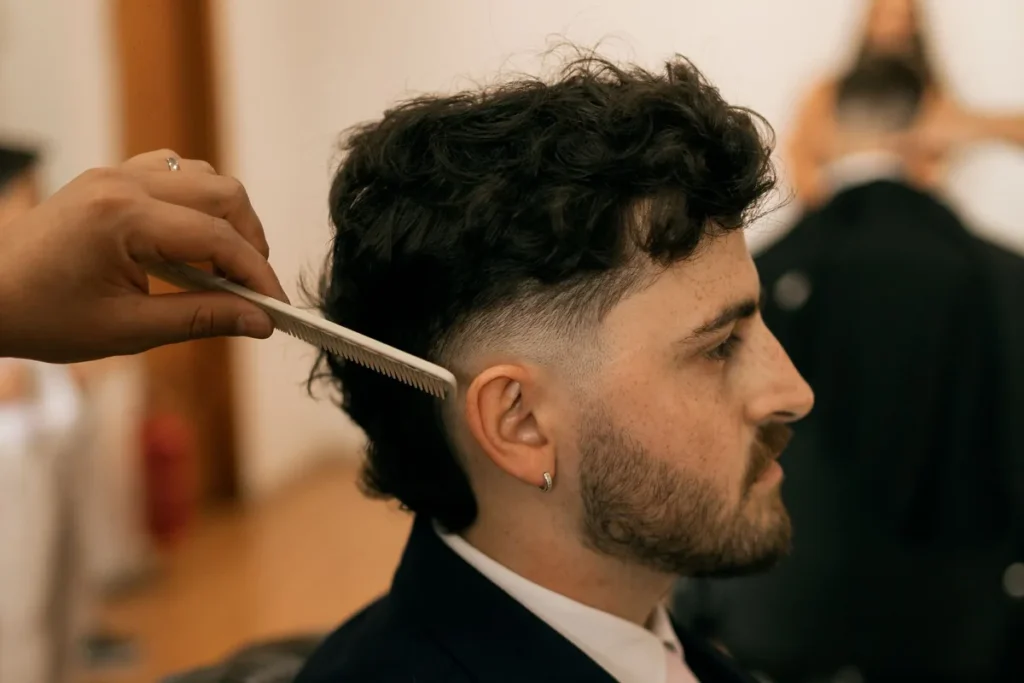
5. Curls, twists or short locs
Curls and twists suit a mid fade beautifully, and many barbers will suggest the drop version here. Sponge twists, two-strand twists and short locs all look good with it. For loc ideas that pair well with a fade, see our dread styles for men guide.
6. Buzz cut with a mid fade
The buzz cut version is the lowest-maintenance cut you can get. Ask for a #2 to #4 on top and a fade down to skin or a #0.5.
7. Mid fade with a beard
If you have a beard, tell your barber to fade the sideburns into it. The worst mid fade with a beard is the one with a strip of bare skin between the two. The longer the beard, the more gradual that sideburn blend should be.
How to ask your barber for a mid fade
Bring a photo of the fade and, if it’s different, a separate photo of the top you want. Then say something like this:
- “Mid fade, starting around my temples and finishing just under the bump at the back.”
- “Skin at the bottom,” or “a half guard at the bottom, no skin, I get bumps.”
- “About two inches on top. I usually push it forward.”
- “Blend it into the beard,” or “taper the sideburns” if you’re clean-shaven.
- “Natural neckline,” or “squared” if you like a harder finish.
Then let them push back. A good barber will tell you if a cowlick at your crown or the density of your hair will make the photo look different on you. That’s not them being difficult. That’s them doing the job.
How long a mid fade stays sharp
Scalp hair grows about half an inch a month, according to Johns Hopkins Medicine. Do the math and that’s roughly an eighth of an inch a week, which happens to be the full length of a #1 guard.
That’s why a fade ages so quickly. In the first week it’s crisp. By the end of week two the skin at the bottom has grown back to about a #1 and the blend is softer, though still tidy. Somewhere in week three the gradient flattens and the outline gets fuzzy. By week four it looks like an overgrown haircut rather than a fade.
If you like it sharp, book every two to three weeks. If that’s not realistic for your budget or diary, ask for a slightly longer bottom guard. A shadow fade or a mid taper will usually stretch to three or four weeks without looking neglected.
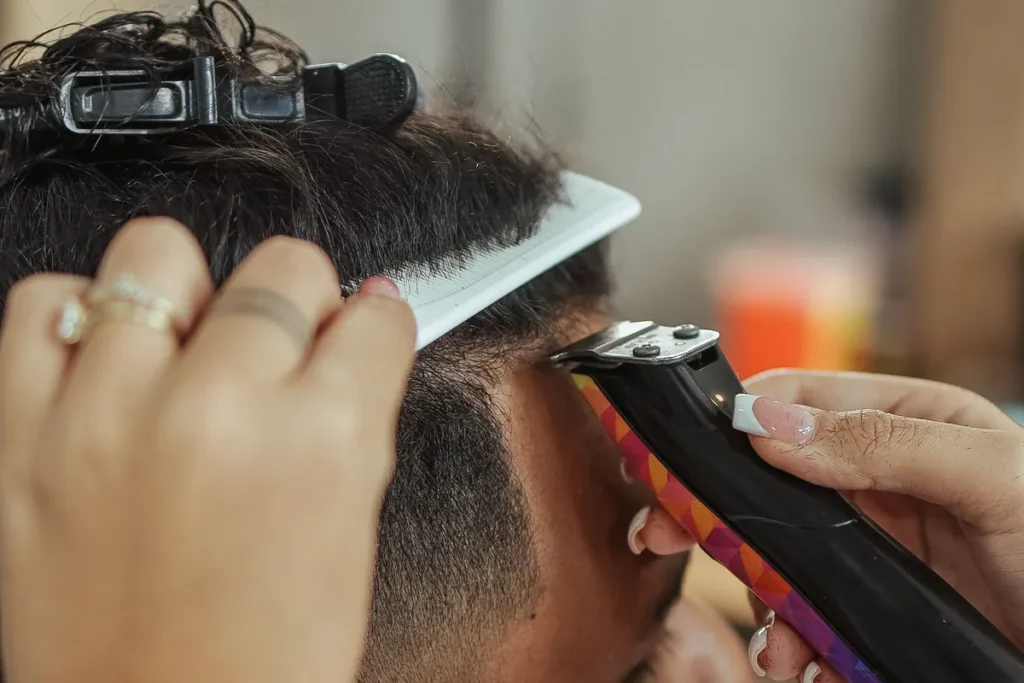
Can you clean it up at home in between? A little. Tidying the neckline and around the ears with a trimmer and a hand mirror is fine, as long as you follow the shape your barber left. Wahl’s own tip is to start with a longer guard than you think you need, which is good advice for anyone holding clippers to their own head. Re-cutting the blend yourself is another matter. You can’t see the back, and a fade needs a steady hand at angles you simply can’t reach. I’d leave that to the barber.
Products and a few extras
Matte clay or paste suits textured crops and anything messy. Work a small amount through dry hair with your fingertips. Water-based pomade is better for side parts, slick backs and pompadours because it rinses out without a fight. Curly and coily tops usually need a leave-in conditioner or curl cream more than any hold product.
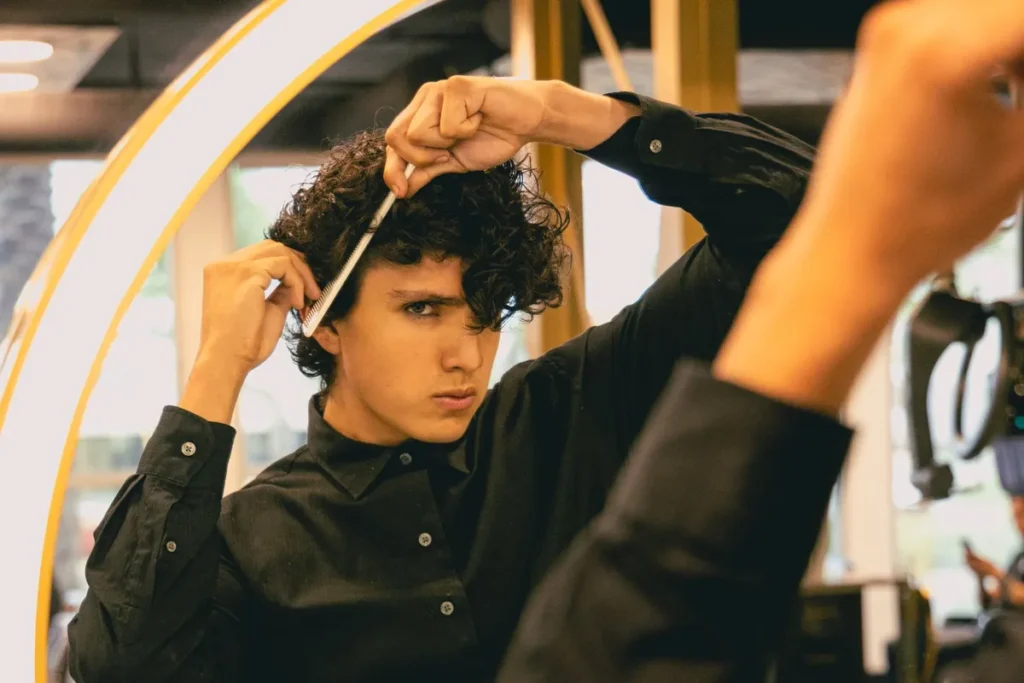
One thing guys forget is the faded skin itself. Flakes and irritation show up much more on a short fade, so wash gently and don’t scratch at the nape after a skin fade.
And if you’re bored of the same cut, color is an easy way to change it without touching the length. Hidden shades under the top layer, like the men’s ideas in our peekaboo hair guide, look sharp against short faded sides.
Quick answers
Is a mid fade the same as a medium fade?
Yep. Same height, two names. Some barbers just prefer one word over the other.
Which is better for work, a mid fade or a mid taper?
The mid taper is more conservative, since only the sideburns and nape get short. If you want a bit more edge, a mid fade with a shadow bottom is a good compromise.
How much hair do I need on top?
At least an inch for a textured crop, two to three inches for a quiff or slick back, and three to five for a proper pompadour. With curls it depends on how tight they coil.
Will a skin fade give me razor bumps?
It can, especially with curly or coily hair. Leaving at least 1 mm at the bottom is the simplest way to reduce the risk.
More cut ideas live in the HairBrave haircuts section, and you’ll find styling tutorials among our hairstyle guides.