
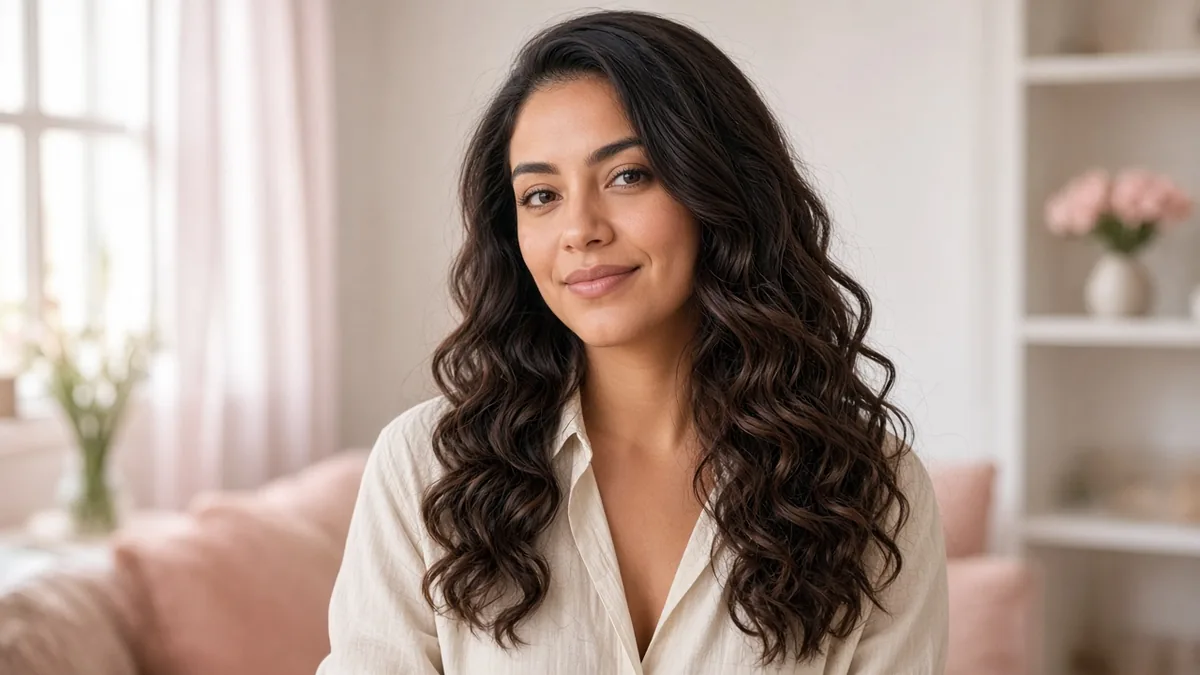
2c hair is the curliest end of the wavy family: thick S-shaped waves that start close to the root, often with a few proper ringlets mixed in, and a strong tendency to frizz. If your hair looks straight-ish when you brush it out but turns into defined waves the minute you leave it alone with some product, you’re probably here.
It’s also the most misread hair type I can think of. People with 2c hair get told to brush it, blow it straight, use heavy curl products made for coils, or skip conditioner because their roots feel flat. Every one of those can make it worse.
The fix is usually subtraction: less brushing, less product weight at the root and more water in the hair when the product goes in. The label itself matters less than any of that.
What 2c hair looks like
The numbers come from the hair typing chart stylist Andre Walker introduced in the 1990s. Type 1 is straight, 2 is wavy, 3 is curly and 4 is coily, and the letters run from loosest (a) to tightest (c). So 2c is wavy hair at its tightest, sitting right on the border with 3a curls.
In practice, 2c hair tends to have a few traits in common. The S-shape starts near the root rather than halfway down. The waves are wide and deep enough to clump into sections. Some strands spiral into loose ringlets, especially underneath and around the face. And it frizzes easily, often from the moment it starts drying.

Worth knowing before you build a whole routine around a label: the chart describes how hair looks, not how it behaves. In Allure’s breakdown of the curl pattern chart, Baylor dermatologist Dr. Oyetewa Asempa says the system has “no biological or scientific basis” and suggests that porosity and the condition of your hair are better starting points. The chart has also been criticized for treating looser, Eurocentric textures as the default.
I still find “2c” useful as shorthand. It tells a stylist roughly what they’ll see when your hair dries. But it won’t tell you which conditioner to buy. Porosity and density do that, and we’ll get to them shortly.
2b, 2c or 3a?
This is the question that sends most people down a rabbit hole. The clearest test uses clean hair that has dried without brushing, heat or much product.
| 2b | 2c | 3a | |
|---|---|---|---|
| Where the bend starts | Mid-length | Near the root | At the root |
| Shape | Loose, flatter S-waves | Deep S-waves, some ringlets | Mostly loose spiral curls |
| Root volume | Fairly flat | Some lift | Noticeable lift |
| Frizz | Moderate | High | Moderate to high |
| Wrap a strand round a finger | Barely bends | Bends, partly springs back | Forms a clear loop |
Most heads aren’t one type, and that’s normal. It’s very common to have 2b on top, where the hair gets the most friction and sun, with 2c or even 3a underneath and at the nape. Style for the dominant pattern and give the curlier sections a little extra product.

Can 2c turn into 3a? Your pattern can tighten or loosen with hormones, age and damage, and plenty of people find their hair gets curlier once they stop brushing it dry and swap to gentler products. That isn’t the hair changing type so much as finally being allowed to show its real shape.
Porosity and density, the two things that matter more
Porosity is how easily your hair takes in and lets go of water. A rough at-home read: after washing, does your hair soak up water and products fast and dry quickly? That points to high porosity, which is common if you bleach, color or use a lot of heat. Does water bead on it and products seem to sit on top? That’s low porosity.

Density is how much hair you have, not how thick each strand is. If you can easily see your scalp when you part your hair, it’s lower density.
Why does this matter more than the letter? Because two people with “2c hair” can need opposite products. Fine, low-density, low-porosity 2c waves will collapse under a rich curl cream. Coarse, dense, bleached 2c hair might drink it and ask for more.
Washing 2c hair without making it frizzier
Frizz on wavy hair is partly a charge problem. A review of hair cosmetics explains that strong anionic surfactants, the cleansers often listed as sulfates, can increase the negative electrical charge on the hair surface, which increases frizz and friction between strands. Conditioners carry a positive charge that helps neutralize it.
pH plays a part too. A 2014 study on shampoo pH concluded that lower-pH shampoos may cause less frizz, and found that only 38% of the popular brand shampoos it tested had a pH of 5 or below, compared with 75% of salon shampoos.
What does that mean at the sink?
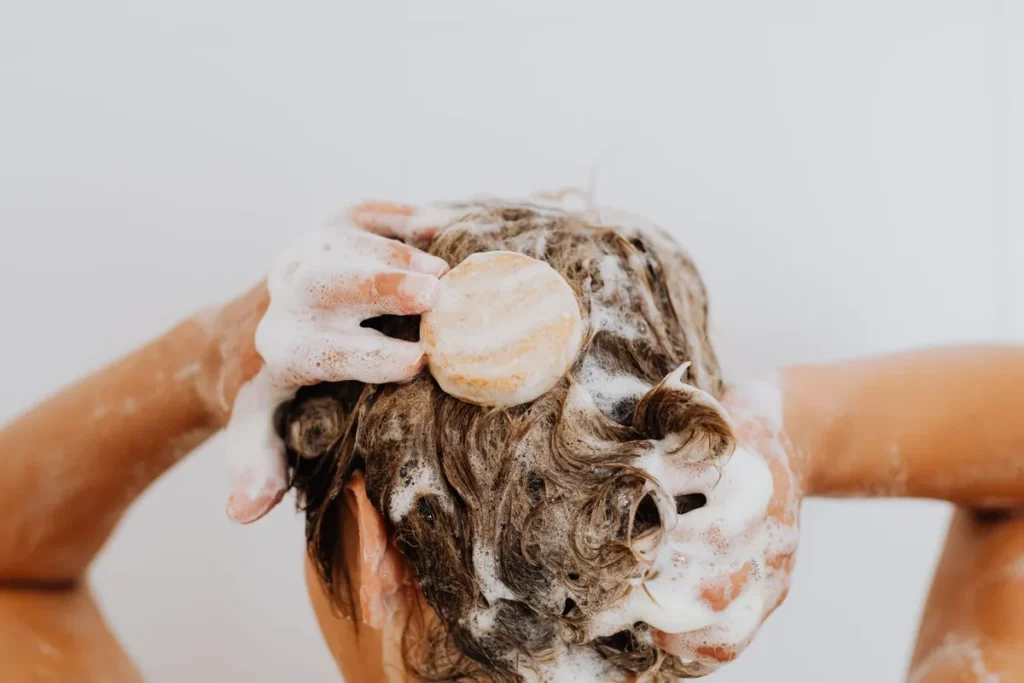
Use a sulfate-free or gentle shampoo for regular washes, focused on the scalp. Let the suds run down the lengths rather than scrubbing them. Most 2c hair is happy with two or three washes a week, though an oily scalp may want more.
Condition every single time. The American Academy of Dermatology recommends conditioner after every shampoo, and for wavy hair it’s the step that does most of the de-frizzing. Detangle while the conditioner is in, with your fingers or a wide-tooth comb, starting at the ends.
But gentle shampoo has a catch. Gels, creams and hard water build up, and waves start to look limp and stringy. If that happens, a clarifying wash every two to four weeks resets things. Follow it with a longer conditioning step, since clarifying shampoos are harsher by design.
What about co-washing?
Co-washing means skipping shampoo and cleansing with a conditioner. It suits some dry, coarse 2c heads, especially in winter, but it is risky on fine hair or an oily scalp because conditioner is not designed to lift oil. If you try it, keep shampooing the scalp once a week and clarify when waves start to look limp.
A 2c hair routine that actually defines the waves
This is the part where technique matters more than the products. Most frizzy 2c hair I’d describe as under-handled when wet and over-handled when dry.
- Apply products to soaking wet hair. Not towel-dried, soaking. Water helps the waves clump, and products spread more evenly. Flip your head forward or to the side.
- Layer light to heavy. A leave-in conditioner first if your hair is dry or colored. Then a curl cream or mousse. Then a gel if you want hold. Fine hair can skip straight to mousse.
- Glaze, then scrunch. Smooth each product over the surface with flat palms (stylists often call it “praying hands”), then cup sections from the ends and squeeze up toward the scalp. You should hear a squelch.
- Blot, don’t rub. Squeeze out excess water with a cotton t-shirt or microfiber towel. A regular terry towel roughs up the cuticle and breaks up your clumps.
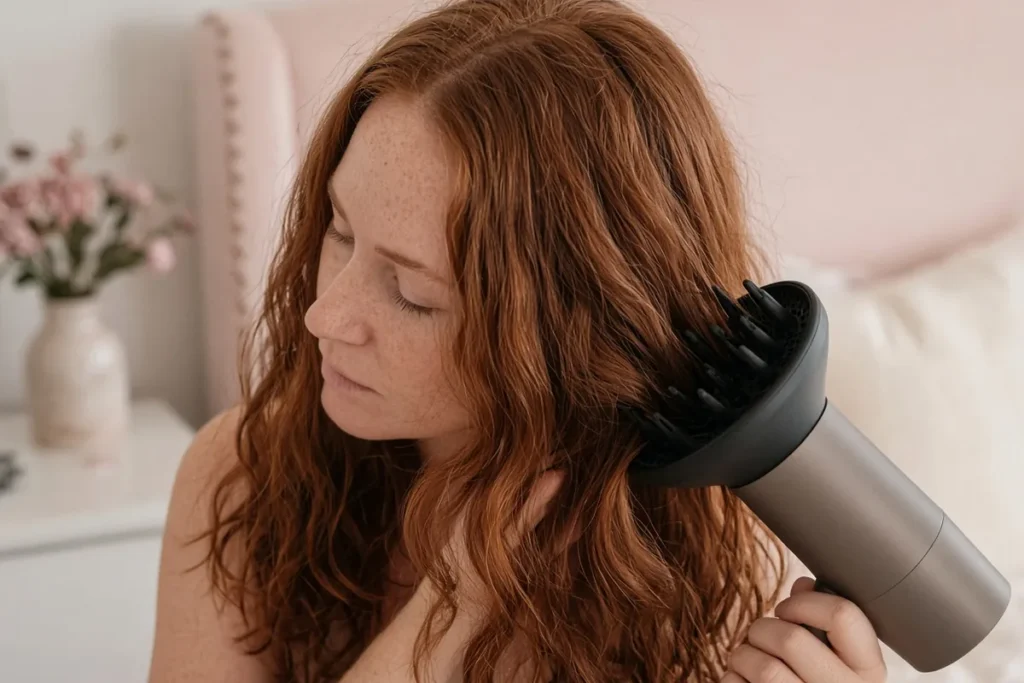
- Leave it alone while it dries. Air-dry, or diffuse on low heat and medium airflow, cupping sections into the diffuser bowl and lifting toward the roots. Don’t touch it until it’s at least 80% dry.
- Scrunch out the crunch. If your gel dried into a hard cast, that’s good. Once your hair is completely dry, scrunch gently, or use a drop of oil on your palms, to soften it.

A few things make a bigger difference than people expect. Keep your hands off it while it dries. Skip the brush on dry hair entirely, because that turns waves into a fuzzy triangle in seconds. And if you’re using heat, the AAD’s advice is to use the lowest setting that gets the job done.
On day two or three, mist your hair with water (a leave-in diluted in a spray bottle works well), scrunch in a little mousse or cream on the frizziest sections, and let it dry again. A silk or satin pillowcase and a loose “pineapple” ponytail on top of your head overnight help waves last longer. If they’ve fallen flat, a few loose braids slept in can bring texture back, like the braid set in our crimped hair guide, only looser.
Plopping for faster drying
If your hair takes hours to air-dry, plopping helps. After the products go in, lay a cotton t-shirt flat, flip your head forward onto it so your lengths coil on the fabric, then wrap the sides around and tie them at the nape. Fifteen to twenty minutes is enough for 2c hair. Longer than that and the waves can dry flattened against the crown.
Products for 2c hair, by what your hair needs
Skip the hype and match product types to your porosity and density.

| Your hair | Start with | Go easy on |
|---|---|---|
| Fine, low density | Lightweight mousse, light gel, root spray | Rich curl creams, heavy oils, butters |
| Medium, average density | Light curl cream plus a gel for hold | Layering four or five products |
| Coarse or dense | Leave-in, curl cream, firmer gel | Very light mousse alone (not enough control) |
| Bleached, colored or high porosity | Leave-in conditioner, cream, bond-building treatments | Frequent clarifying and high heat |
Most people over-product 2c hair. If your waves look stringy or greasy by lunchtime, use less. A walnut-sized amount of gel is plenty for shoulder-length hair.
Haircuts for 2c hair
The cut matters as much as anything you put on it. A blunt one-length cut on 2c hair often ends up as the classic triangle: flat on top, wide at the bottom.

Long layers fix that. They take weight off the bottom so the waves can bounce up, and face-framing layers bring out the ringlets that tend to form around the face anyway. A curtain fringe works well on 2c hair, provided you accept it will never sit as straight as it does in the salon. Still deciding on a fringe? Our guide to the types of bangs compares them by hair type.
How it’s cut is just as important. A stylist who cuts curly and wavy hair dry, or at least checks it dry, can see where each wave falls before taking length off. If yours only ever cuts it wet and stretched, ask them to finish dry. And if your pattern varies a lot across your head, it’s worth booking with someone who specializes in curly cuts. A trim every 10 to 12 weeks keeps the ends from going frizzy and see-through.
Thinking of adding color? Hidden color under the top layer, like the ideas in our peekaboo hair guide, shows off waves really nicely as they move. Just remember bleach raises porosity, so your routine will need more moisture afterwards.
2c hair for men
Plenty of men go looking for 2c hair advice, and it’s easy to see why. Short wavy hair is hard, because the waves need some length to form at all.
Below about two inches, most 2c hair just looks thick and a bit unruly. Somewhere around three to five inches on top is where the S-shape properly shows up. So if you’ve always kept it short and never seen your waves, that’s probably why.
For the sides, a scissor cut or a soft taper keeps the shape natural. A fade works too, and the contrast between short sides and waves on top looks sharp. Our mid fade guide covers how to ask for one without it going too high. Bear in mind that a fade on wavy hair needs a recut every few weeks.

Styling is the same idea as for longer hair, just with less product. Rake a little cream or a light gel through wet hair, scrunch with your hands, and let it dry. Sea salt spray adds grit but can be drying, so I’d use it on unwashed days rather than every day. And again, don’t brush it when dry.
Questions people ask about 2c hair
Is 2c hair wavy or curly?
It’s technically wavy, the tightest wavy type. But it often has some curls mixed in, so it’s fair to call it wavy-curly. What you call it matters less than giving it moisture and leaving it alone while it dries.
Do I really need sulfate-free shampoo?
Not necessarily. Gentle, lower-pH cleansers do tend to mean less frizz, but plenty of 2c heads cope fine with a regular shampoo on the scalp and conditioner every time. Use a clarifying shampoo occasionally either way.
Why are my waves flat at the roots?
Usually it’s product weight, too much conditioner near the scalp, or sleeping on it flat. Keep rich products on the mid-lengths and ends, try clipping the roots up while diffusing, and flip your part.
How do I stop 2c hair frizzing in humidity?
A firmer gel cast is your best bet, applied to soaking wet hair and left untouched until dry. Some frizz on humid days is normal for this hair type, so aim for less frizz rather than none.
Should I brush 2c hair?
Only when it is wet and full of conditioner, with a wide-tooth comb or a detangling brush. Brushing dry 2c hair breaks the wave clumps apart and leaves frizz that no product will fix until the next wash.
How often should I wash 2c hair?
Two or three times a week suits most people. Wash more often if your scalp gets oily or itchy, and use the in-between days for a water-and-product refresh.
For more routines and product explainers, the HairBrave haircare section is the place to start.