

The main types of bangs are blunt, curtain, wispy, side-swept, micro and curly, and almost every other fringe you’ll see is a variation on one of those. Which one you pick should depend less on your face shape than most guides claim. Your hair’s texture matters more, and so does how much styling you will really do on a Tuesday morning.
I say that as someone who loves bangs. They’re the fastest way to change a haircut without losing length. But they’re also the cut people regret most quickly when it doesn’t match their hair, so choose with your hair, not a mood board.
Each of the types of bangs below comes with who it suits and how much upkeep it takes, followed by a face-shape table and the checks to make before anyone picks up the scissors.
Types of bangs at a glance
Here’s a quick comparison before we get into the details. Upkeep here means how often you’ll likely want a fringe trim and how much daily styling it needs.
| Type | Length | Best hair types | Upkeep |
|---|---|---|---|
| Blunt | Brow length, one straight line | Straight, thick | High |
| Curtain | Cheekbone length, center part | Most, especially wavy | Low to medium |
| Wispy | Brow length, sheer | Fine to medium | Medium |
| Side-swept | Long, diagonal | Almost all | Low |
| Micro (baby) | Mid-forehead | Straight, thick | High |
| Curly | Varies, cut dry | Wavy, curly, coily | Low to medium |
The six main types of bangs
These are the cuts you can ask for by name in almost any salon.
Blunt bangs
Blunt bangs are cut in one straight, solid line, usually right at the eyebrows or just under them. They’re bold and graphic. They also hide nothing, so a crooked cut or a cowlick shows immediately.

I’d recommend blunt bangs most for thick, straight hair. The weight helps them hang flat. On fine hair they can separate and look stringy by lunchtime, and on curly hair the line won’t stay straight anyway.
They’re also the highest-maintenance option on this list. A blunt fringe that’s half an inch too long is suddenly in your eyes, and since hair grows roughly half an inch a month according to Johns Hopkins Medicine, you’ll probably want a trim every two to four weeks. Many salons offer quick fringe trims between full cuts, so ask about that before you commit.
Curtain bangs
Curtain bangs part in the middle and sweep out to each side, shortest at the center and longest near the cheekbones. They frame the face rather than covering it. They’re the most forgiving choice for a first fringe, because if you hate them you can tuck them behind your ears or blend them into your layers.
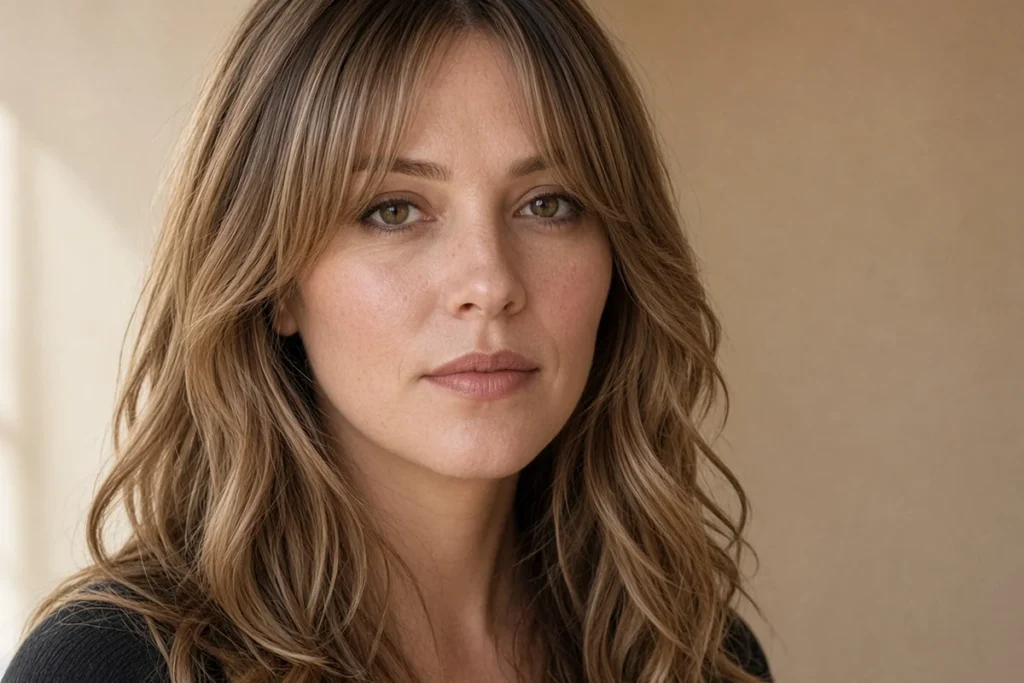
They work on most hair types and look especially good on waves. If your hair sits somewhere around 2c, curtain bangs can follow your natural bend instead of fighting it.
Curtain bangs have enough variations to fill a whole post, so I’ll keep this brief. The big styling tip is to blow-dry each side away from the part with a round brush.
Wispy bangs
Wispy bangs are light and sheer, cut with lots of point-cutting so you see bits of forehead through them. They’re softer than blunt bangs and easier to grow out.
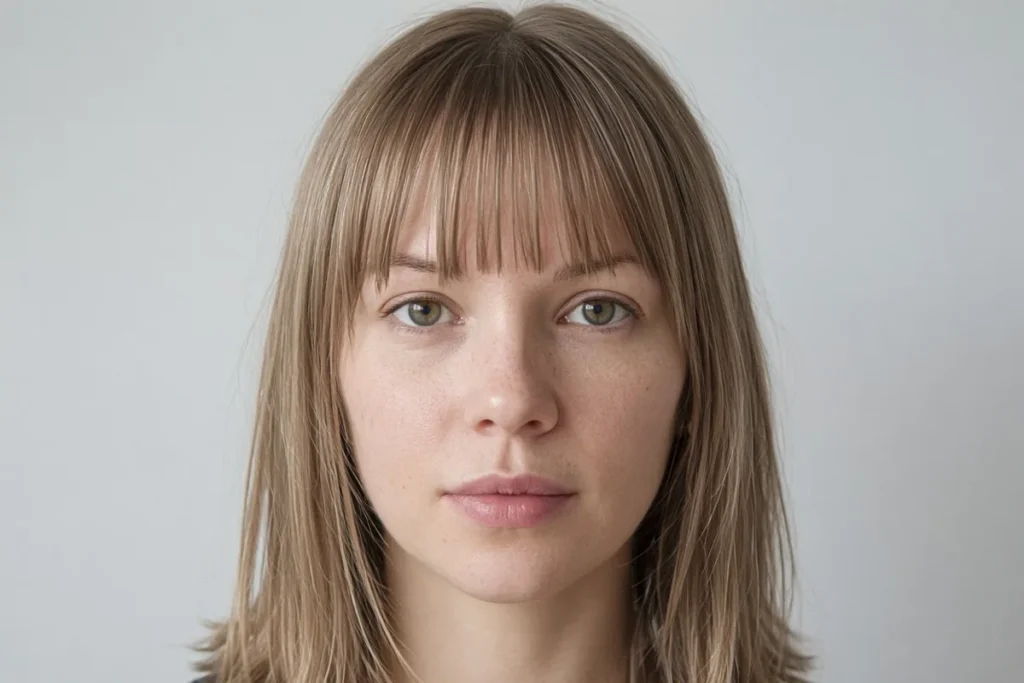
These are often the best option for fine hair, since a full blunt fringe can use up too much hair from the front and make the rest look thin. The catch is that wispy bangs get greasy quickly because there’s so little hair holding them up. A tiny bit of dry shampoo at the roots helps.
See-through bangs are basically the K-beauty version of wispy bangs, even sheerer and lighter.
Side-swept bangs
Side-swept bangs start from a side part and fall diagonally across the forehead, usually long enough to reach past one eyebrow. They’re low drama and low maintenance, and they work for nearly everyone.

I’d suggest them to anyone nervous about bangs, and especially to anyone with a strong cowlick at the front. They’re also a good way to grow out a shorter fringe. Once blunt bangs reach the cheekbone, just sweep them to the side.
Micro bangs
Micro bangs, also called baby bangs, are cut short, well above the eyebrows. They’re a statement cut, and they work best when you commit to the look with confidence.

Thick, straight hair is the easiest texture for micro bangs. With cowlicks or fine hair, short bangs tend to stick up, and there isn’t enough length to weigh them down.
Be honest with yourself about growing them out. Micro bangs pass through several in-between lengths, and none of them are especially easy to style. If you liked the Y2K era, you’ll remember how long that grow-out takes.
Curly bangs
Curly bangs might be my favorite of all the fringes, because they look so natural. They’re cut dry, curl by curl, so each one sits where it wants to. They’re soft and full, and they rarely look “too done.”

The most important thing is that the stylist cuts them dry and leaves them longer than you think. Curls shrink, sometimes by several inches, so a fringe cut wet at brow level can spring up to your hairline once it dries. That shrinkage is especially dramatic on tighter textures like 4b hair.
Styling usually just means refreshing them with a bit of water and leave-in, then letting them air dry or diffusing on low.
Other bangs you’ll hear about
A few more names come up in salons and on social media, and most of them are hybrids of the six main types of bangs above.

Bottleneck bangs sit somewhere between curtain and wispy. They’re narrow at the top and wider and longer at the sides, like the neck of a bottle. Birkin bangs, named after Jane Birkin, are long and a little piecey, landing at or just below the brows.
Choppy bangs have a deliberately uneven edge, usually cut with a razor or by point-cutting. Asymmetrical bangs run longer on one side, and they can be anything from barely noticeable to very edgy.
Then there are face-framing bangs. They blend into the front layers so well that the fringe almost disappears into the cut, which makes them a good bridge if you’re still unsure.
How to choose the right type of bangs
Face shape guides for the different types of bangs are everywhere, and they’re not useless. Blunt bangs can shorten a long face, and side-swept bangs soften a square jaw. But I’d put face shape third on the list.
If you want the short version anyway, here it is. Treat it as a tiebreaker, not a rule.
| Face shape | Bangs that usually flatter | Use care with |
|---|---|---|
| Oval | Almost any, including blunt and micro | Very heavy bangs on fine hair |
| Round | Curtain, side-swept, longer wispy | Short, straight-across blunt bangs that add width |
| Square | Side-swept, curtain, soft wispy | Blunt bangs with a hard straight line |
| Long or oblong | Blunt or full curtain bangs that sit at the brow | Very short micro bangs |
| Heart | Curtain, side-swept, wispy | Thick blunt bangs that make the forehead look heavier |
Start with your hair texture. Fine hair usually suits wispy or curtain bangs. Thick straight hair can handle blunt or micro, while curly hair is happiest with curly or curtain bangs.
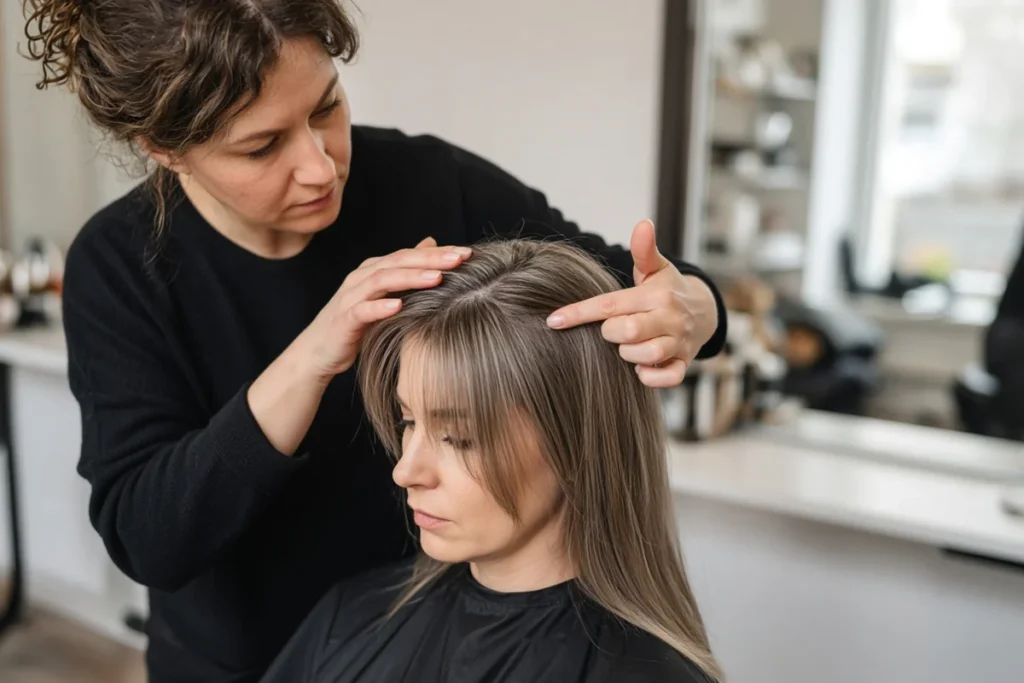
Then check your cowlicks. This one gets skipped constantly.
Push your hair forward and see where it naturally splits or stands up at the front. A study in the Journal of the American Academy of Dermatology on scalp hair patterns noted that cowlick whorls can appear anywhere along the frontal hairline, so it’s worth checking yours before you book. A strong cowlick right at center front is usually a sign to choose side-swept or curtain bangs over blunt.
Think about your skin, too. Bangs sit right on your forehead all day. The American Academy of Dermatology says oils in hair products can cause small breakouts along the hairline and forehead, and it suggests choosing products labeled “non-comedogenic” or “oil-free.” If you’re breakout-prone, keep heavy creams and pomades off your bangs.
Finally, be realistic about time. If you air dry and run out the door, go for something longer and softer that forgives a bad hair day. If you enjoy a five-minute blow-dry, blunt and micro are fair game.
With glasses
Glasses wearers can absolutely have bangs, but the length matters. A fringe that rests on the top of your frames will get pushed around and look messy within an hour.

I’d go one of two ways. Either keep the bangs short enough to sit above the frames, or long enough to sweep past them to the side. Curtain and side-swept bangs are the most comfortable for most people with glasses. Blunt bangs can look great too, as long as they’re cut to clear the frames.
Thick hair versus fine hair
Thick hair can carry almost any fringe, but it often needs weight taken out so the fringe doesn’t sit like a helmet. Ask your stylist to texturize the inside of the bangs instead of only thinning the ends.

Fine hair is trickier. The stylist needs to borrow hair from further back to make a fringe look full, and that can leave the sides looking thin. Keeping the section narrow and the cut wispy is usually the better bet.
If your hair is somewhere in between, you’ve got the most choice of all.
Styling and keeping bangs fresh
Whichever fringe you pick, the first week is the learning curve.
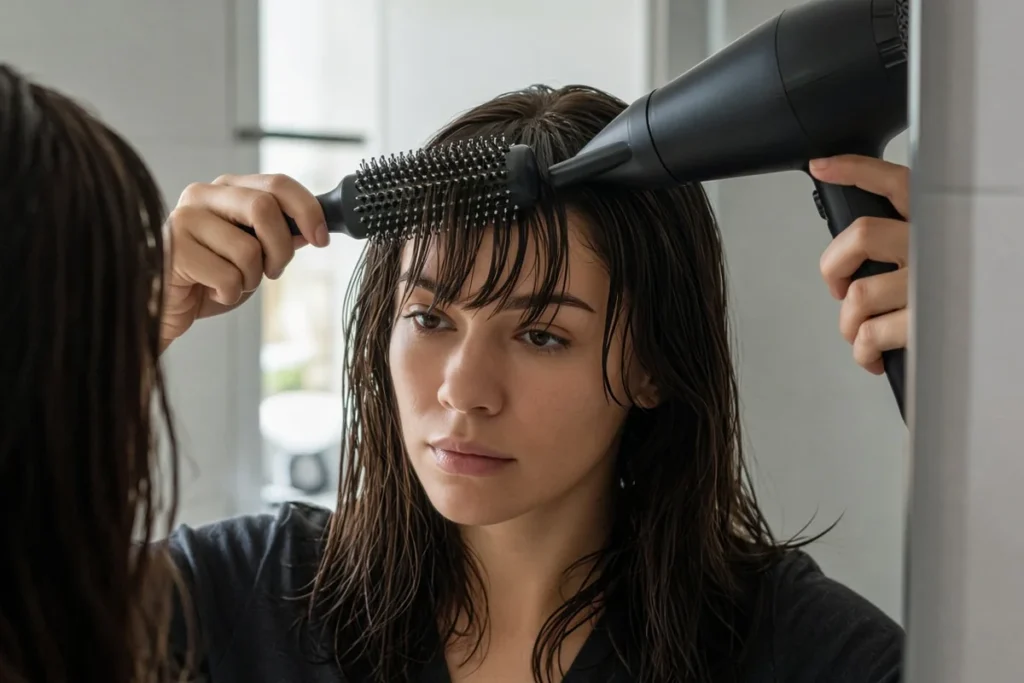
Most straight-hair bangs look best when you dry them first. They dry fastest, and if they air dry flat they’re hard to fix later. Blow-dry them while they’re still damp, using a small round brush or your fingers, and move the brush side to side across the forehead to undo any cowlick.
Use the lowest heat that works. The American Academy of Dermatology recommends low or medium heat and a heat protectant for regular blow-drying, and bangs get heat more often than the rest of your hair.
When your fringe gets oily before the rest of your hair, you can wash just the bangs in the sink. It takes two minutes and buys you another day.
And don’t trim them yourself with kitchen scissors. If you must, cut vertically into the ends in tiny snips rather than one straight snip across. A straight cut on wet hair almost always ends up shorter and more crooked than you planned.
Before the scissors come out
Bring photos of the exact fringe you want, and ideally a photo of one you don’t want. The words “bangs” and “fringe” mean different lengths to different people, so a picture saves a lot of confusion.

Tell them how you style your hair most days. If you never use a blow dryer, say so. A good stylist will steer you toward a fringe that suits your routine as well as the photo.
Ask them to show you how to style the bangs before you leave. Two minutes of watching them blow-dry it is worth more than any tutorial later.
If you’re on the fence, try clip-in bangs first. Or ask your stylist to cut them a little longer than you want, and take them shorter at the next appointment. You can always cut more.
For more cut ideas, browse our haircuts section, or head to our hairstyles section for ways to wear a fringe once you’ve got one.
Your bangs questions
What type of bangs is easiest to maintain?
Side-swept and curtain bangs are the easiest types of bangs to live with. They’re longer and blend into your layers, so they still look fine when they’re overdue for a trim.
Do bangs suit every face shape?
Some version of bangs suits nearly every face shape. Your hair texture and any cowlicks at the front are bigger factors in choosing a fringe.
How often do bangs need trimming?
Blunt and micro bangs usually need a trim every two to four weeks. Longer, softer styles can often go six to eight weeks.
Can you have bangs with curly hair?
Absolutely. Ask for them to be cut dry and longer than you think you want, because curls shrink when they dry.
Should you get bangs if you have a cowlick?
You can, but pick the style carefully. Side-swept or curtain bangs work with the cowlick instead of against it, while blunt bangs tend to fight it.