

A skin fade is a haircut where the sides and back are blended all the way down to bare skin, so there’s no visible hair at all at the bottom of the fade. Barbers also call it a bald fade, and the two names mean the same cut.
It’s the sharpest fade you can get. It’s also the one with the shortest shelf life.
Scalp hair grows about half an inch a month, according to Johns Hopkins Medicine. That works out to roughly an eighth of an inch a week. On a fade that starts at zero, an eighth of an inch is the difference between “fresh” and “needs a cut.” So before you book one, it helps to know exactly what you’re signing up for.
What makes a fade a skin fade
Every fade is a gradient from longer hair on top to shorter hair below. What separates this one from the rest is how far down that gradient goes.
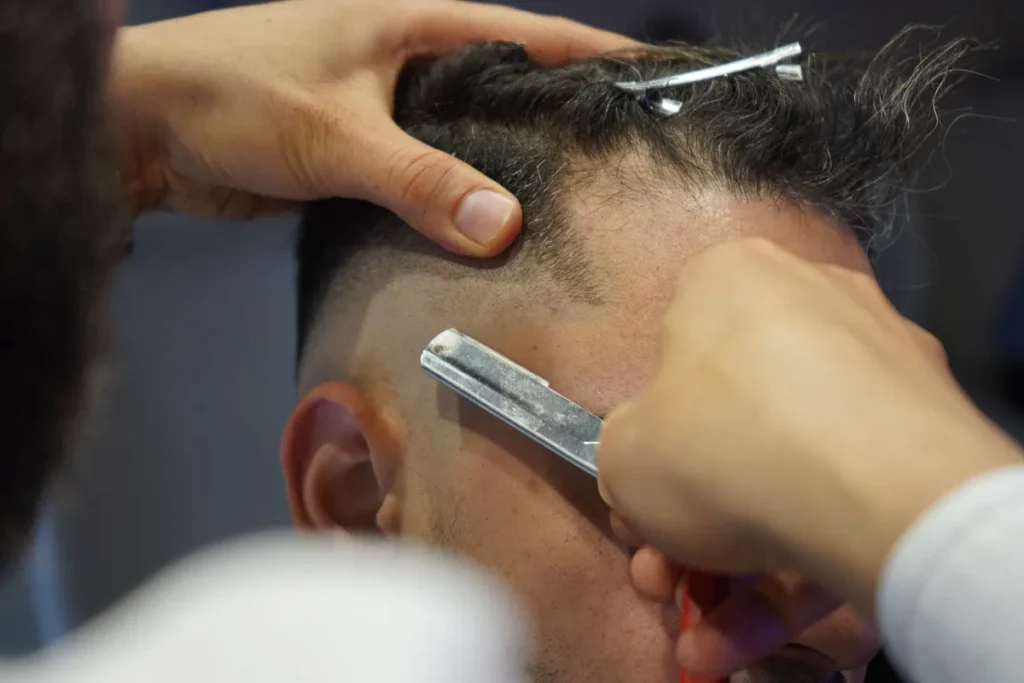
A barber builds the fade with clipper guards first, working down to a closed blade with no guard at all. That still leaves a faint shadow of stubble. To get to genuine skin, they then go over the bottom section with a foil shaver or, for the cleanest finish, a straight razor. That last pass is what gives a fresh one its smooth, almost airbrushed look.
Here’s how the bottom of a fade can be finished, from softest to sharpest:
| Finish at the bottom | How it’s done | What you see |
|---|---|---|
| Shadow fade | #0.5 or #1 guard | A visible shadow of short hair |
| Zero fade | Clipper with the lever closed, no guard | A very faint shadow, almost skin |
| Skin (bald) fade | Foil shaver after the clippers | Bare skin, smooth to the touch |
| Razor fade | Straight razor after the clippers | The smoothest, sharpest finish |
People mix up “zero” and “skin” all the time. If you want genuinely bare skin, say “skin” or “bald,” not “zero.”
Low, mid or high skin fade?
Where the bare skin starts changes the whole look. A low skin fade keeps the skin to a narrow band just above the ears and along the neckline, so most of the sides stay covered. A mid skin fade takes the skin up to around the temples. A high skin fade carries it close to where the sides of your head start curving toward the top, leaving a much smaller area of longer hair.
If you’re unsure, start in the middle. We go into the landmarks and the guard numbers in detail in our mid fade guide, and the same rules apply here. The only difference is the bottom goes all the way to skin.
High skin fades are bold and photograph really well. But they show regrowth fastest, and they put more scalp on display than most people expect. Seeing a lot of your own scalp in the mirror for the first time can be a shock.
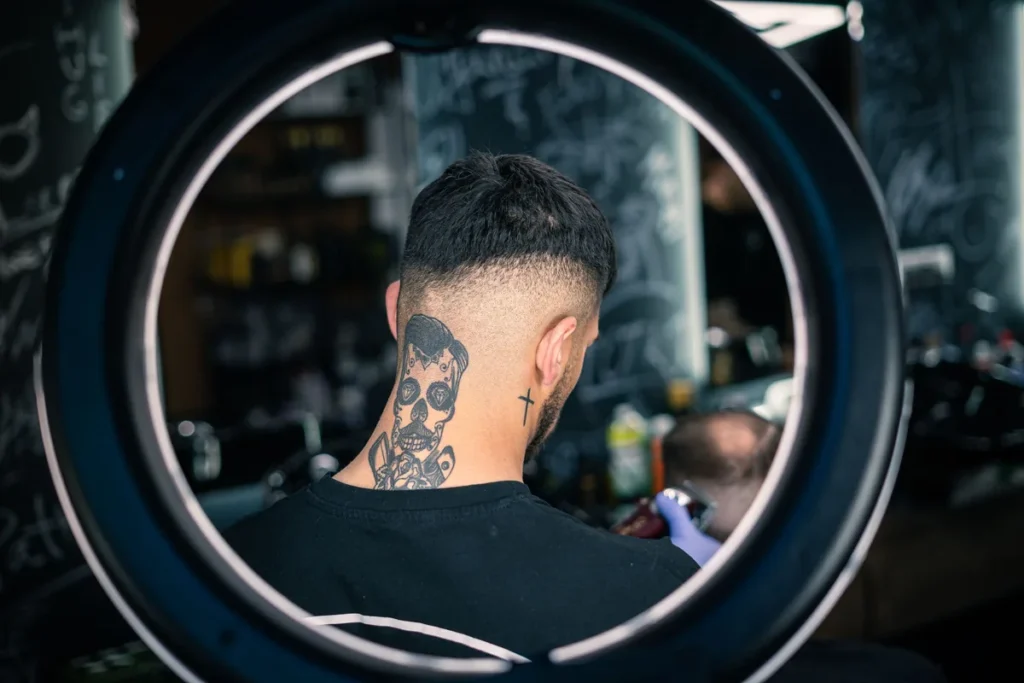
There are a few shapes on top of the height. A drop skin fade curves down behind the ear toward the nape. A burst fades in a half-circle around the ear and leaves the back longer. And a skin taper only takes the sideburns and the very edge of the neckline to skin, keeping everything else longer. The taper is the most subtle option, and the one I’d point you toward if you’ve got a conservative workplace.
Should you get a skin fade?
Most people can wear one. But there are a few good reasons to think twice, and barbers don’t always mention them.
Razor bumps. If your hair is curly or coily, shaving it to the skin can make the regrowing hairs curl back into the skin. That’s pseudofolliculitis barbae. A 2019 review of treatment options notes that electric clippers are linked with fewer bumps than close shaving, on the face and the scalp, and recommends leaving at least 1 mm of hair. If you’ve had bumps after one before, a shadow fade is the kinder choice.
Bumps at the back of the neck that scar. That can be acne keloidalis nuchae. The American Academy of Dermatology lists frequent close-shave haircuts as one of the things that irritate the skin there. It also says you can’t catch it from dirty clippers, which is a common myth. If you’ve got firm bumps or patches where hair has stopped growing, see a dermatologist before your next cut.
Anything on your scalp you’d rather not show. Scars, a bumpy head shape, dandruff or psoriasis patches all become visible the moment the hair is gone. A good barber can work around some of it by changing the height. But it’s worth a mention in the chair.
Face shape and a skin fade
Face shape matters more for the top than for the fade, but height changes the balance. Round and square faces usually suit a mid or high skin fade with some height on top, which lengthens the face. Long or oval-long faces look better with a low skin fade and a fuller top or a fringe, because a high fade plus a tall quiff makes the head look even longer. If you have prominent ears, a low skin fade or a shadow fade keeps them from looking bigger.
Your hair color matters more than people think. Dark, dense hair against lighter skin gives the most dramatic contrast, which is exactly why a skin fade looks so striking on it, and also why every uneven patch in the blend shows. Fair, blond or grey hair is the opposite. The contrast is much softer, so a skin fade can look almost like a very short taper from a distance. If you’re blond and want that sharp look, a higher fade or a razor finish helps.
Head shape is the other one. A fade that goes to skin shows the real outline of your head, including any flat spot at the crown or a ridge at the back. A good barber will place the height to flatter it. That’s one good reason to let them talk you out of a specific height if they think it won’t suit you.
Sun. Bare skin burns. More on that below.
And if none of that applies, go for it. It’s a great cut.

The best tops for a skin fade
The fade frames the haircut, but the top decides the style.
A textured crop with an inch or two on top is probably the most common pairing. The bare sides make the choppy texture stand out, and it takes a minute to style with a little matte clay. A French crop is the same idea with a blunt fringe, and it looks particularly clean over a high skin fade. Grow the top past four inches and tuck the short section underneath it, and you’re into two block haircut territory.

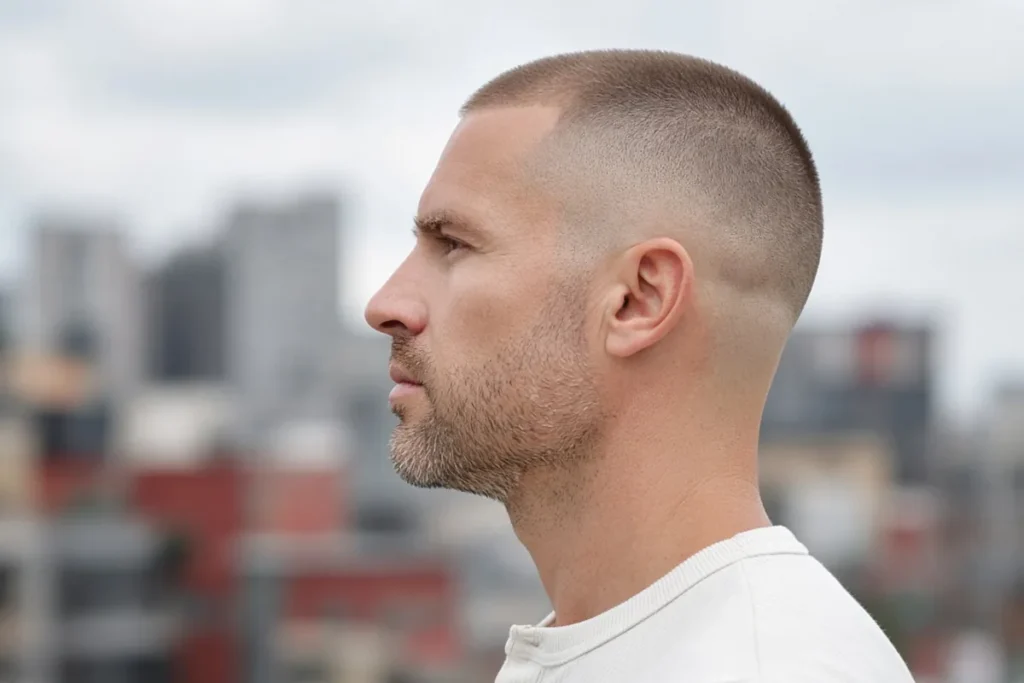
A buzz cut with skin at the sides is the lowest-effort option going. Ask for a #1 to #3 on top. There’s nothing to style. You do need to book regularly, because the faded part is basically the whole look.
Curly and coily tops look great with skin at the sides, because the contrast makes the texture the star. Barbers often pair this with a drop fade so the curve follows the head. If you’re working with tight coils, our 4b hair guide covers moisture and styling for the hair up top. And if your hair is wavy, the tips in the 2c hair guide work just as well for a man’s top section.
For the classic end, a pompadour, slick back or comb over has strong contrast against bare sides and suits straight or wavy hair. You’ll want three to five inches on top, a blow-dryer and a pomade or styling cream.
Got a beard? Tell your barber you want the sideburns faded into it rather than shaved clean. A skin fade with a full beard and a bare strip between them looks unfinished. The usual approach is to keep the skin section above and behind the ear, then bring the length back in through the sideburn so it meets the beard at roughly the same length. The shorter your beard near the ears, the easier that blend is.
How to ask for a skin fade
You don’t need the vocabulary. You need three decisions and a photo.

- Height. Low, mid or high, or just point to where you want the skin to start.
- Finish. “Skin” or “bald” for bare skin, “razor” if you want the sharpest finish, “shadow” or “half guard” if you get bumps.
- Top. How much length you’re keeping and how you usually style it.
Then add the details that are easy to forget. Do you want a line-up at the forehead and temples? A square or natural neckline? Should the sideburns fade into your beard? Bring one clear photo of the fade, ideally from the side.
How long does a skin fade last?
Not long. The bare skin is the first thing to go, and by day three or four you’ll usually see a shadow coming through.
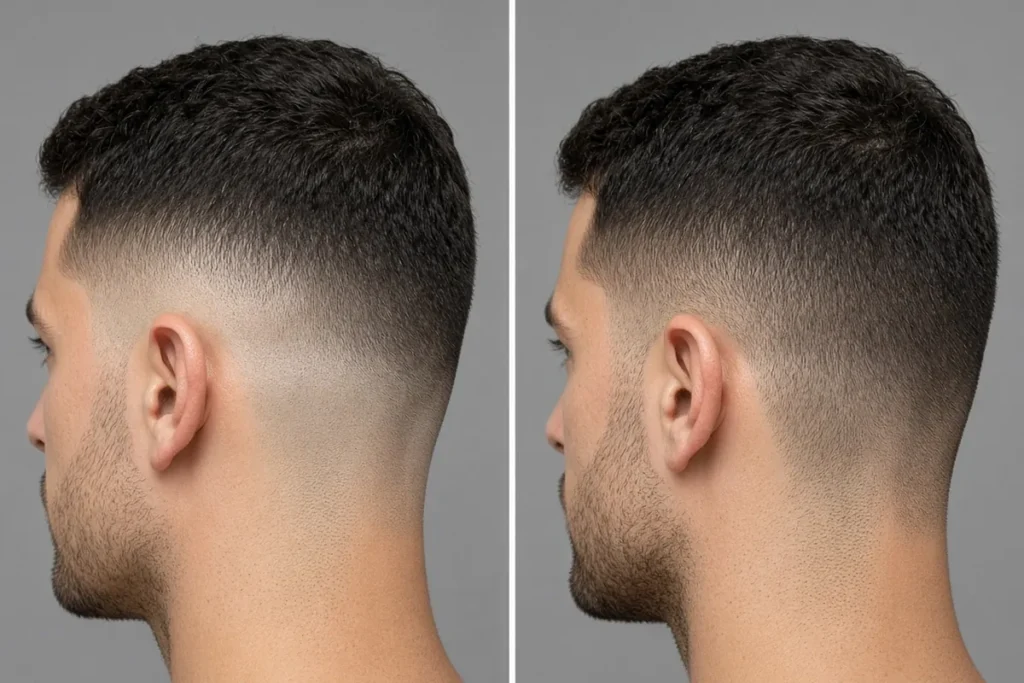
Here’s roughly how it goes. On day one the bottom is genuinely bare. By the end of the first week, that section has grown to about a #1 guard, so the fade is still there but the sharp edge between skin and hair has gone. In week two the outline starts to blur, especially at the neckline. By week three most people can see it’s due.
What does that mean for your wallet? If your barber charges for a full cut every two weeks, a skin fade costs roughly twice as much a year as a cut you’d refresh monthly. That’s not a reason to skip it, just something to know going in.
Most barbers recommend a touch-up every two to three weeks, and if you really like it crisp, every 10 to 14 days. That adds up. Before you commit, think about whether you’ll actually book that often. If not, a shadow fade or a taper is the smarter booking. Some barbers also offer a cheaper “line-up and fade refresh” between full cuts. A shadow fade or a taper looks nearly as clean and stays tidy for twice as long.
Looking after a skin fade
Freshly shaved skin needs a bit of care.

Put sunscreen on it. The AAD’s sunscreen advice is to apply a broad-spectrum, water-resistant SPF 30 or higher to all skin not covered by clothing, and a freshly shaved scalp is exactly that. A stick or a light lotion is easier on the sides of your head than a spray. Or wear a cap.
Wash gently. A mild shampoo, no scrubbing with your nails on the freshly shaved area, and a light, unscented moisturizer if it feels tight or itchy. Leave any bumps alone; picking them is how they scar.
And give your skin a break now and then. If you’re getting shaved down every two weeks and your nape is constantly irritated, try a shadow fade for a cycle or two and see whether it settles.
Skin fade questions
Is a skin fade the same as a bald fade?
Yes. Both mean a fade that goes down to bare skin. “Zero fade” is a different thing: it stops at a closed clipper blade, which leaves a faint shadow.
Skin fade or taper fade: which is better?
A taper only shortens the hair around the sideburns and the neckline. A skin fade takes the whole lower section of the sides and back to skin. The taper is more subtle and lasts longer; the skin fade is sharper.
Does a skin fade hurt?
It shouldn’t. The foil shaver and razor can sting a little on sensitive skin, and some people get redness for a day. If you get bumps every time, switch to a shadow fade.
Is a skin fade a good idea if I’m thinning on top?
It can be. A low or mid version makes the hair on top look denser by contrast, and a short textured crop hides a lot. I’d avoid a high skin fade, though. It shrinks the area of hair on top and pulls attention to the crown, which is usually exactly where thinning shows first.
Can I do a skin fade at home?
You can tidy the neckline with a trimmer. But a full skin fade at home is hard, because you can’t see the back and the blend has to be perfect against bare skin. I’d leave it to a barber.
Can women get a skin fade?
Yes. The most common version is a skin fade at the nape under a longer bob or pixie, or a faded undercut on one side. It is the same cut and the same upkeep, just hidden under more hair.
Find more cuts in the HairBrave haircuts section.