
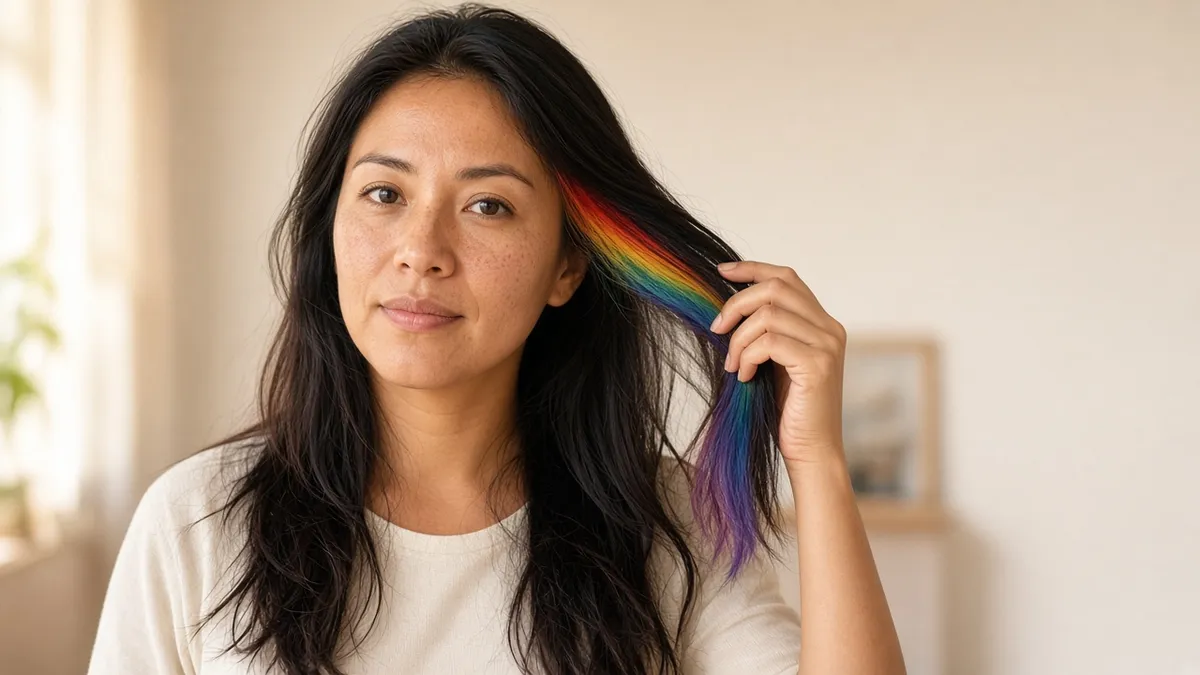
Rainbow hair looks very different depending on where the colors begin. A narrow strip hidden beneath brunette hair can look almost natural when the top layer falls over it.
Put the same colors across the crown and the result is vivid from every angle. The placement you choose decides how much of your hair needs preparation and what you’ll see as it grows.
The catch is the starting base. Pastel pink will not look the same over dark brown hair as it does over pale blonde, and several colors on one head require careful sectioning. Start by choosing how much of your hair you want colored, not the brightest picture in your saved folder.
What rainbow hair means at the salon

A rainbow look uses several fashion shades in the same style, arranged in separated panels, stripes, bands, or blended sections. It doesn’t have to include every color in a textbook rainbow. You can combine a few cool colors, a soft pastel palette, or saturated tones against a darker base.
There are two questions to answer before a colorist starts mixing: which strands will receive color, and what color are those strands now? Hair already lightened or colored may respond differently from your untouched roots. Any plan needs to account for the pigment still sitting in the lengths.
The Sally Beauty color-placement guide explains that vivid and pastel shades are most visible on pre-lightened hair, while deeper shades can read more subtly on dark hair. Think of your starting hair as part of the design, not an empty canvas.
If you’re unsure how visible you want the result, compare a full-head reference with a photograph where a darker top layer covers much of the color. The difference may matter more to your daily routine than the exact order of blue, green, and purple.
Hidden rainbow hair beneath your usual color
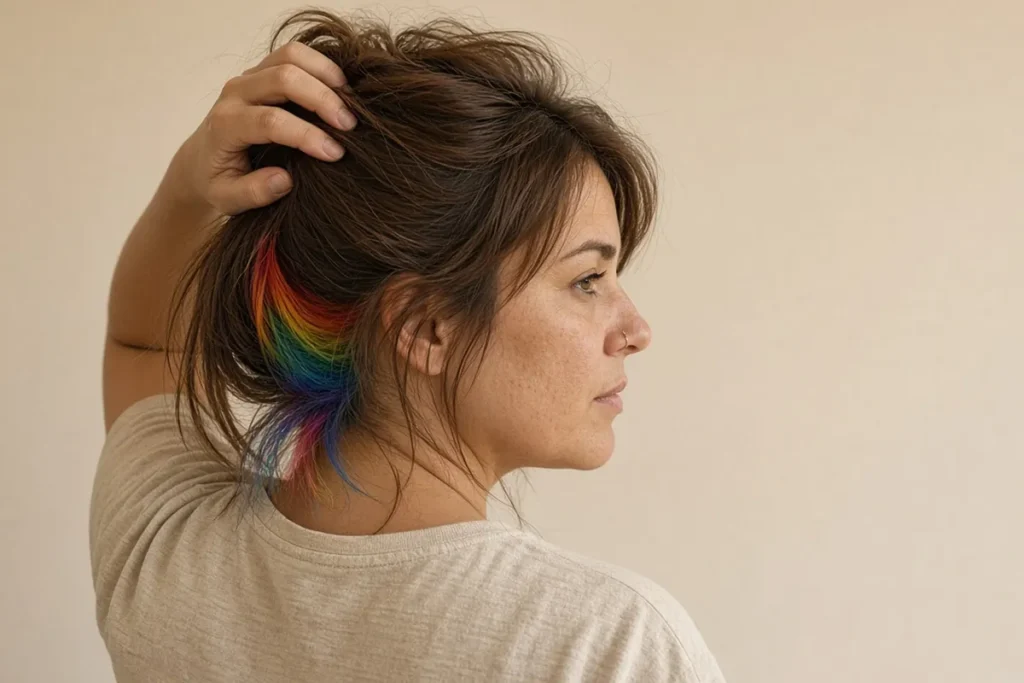
A hidden rainbow hair placement leaves much of the visible surface alone. You can reveal color by parting or lifting the hair and cover it when the upper layer falls naturally. These options still involve dyeing the chosen sections, so they aren’t automatically damage-free or invisible in every hairstyle.
Hidden vertical rainbow underlayer
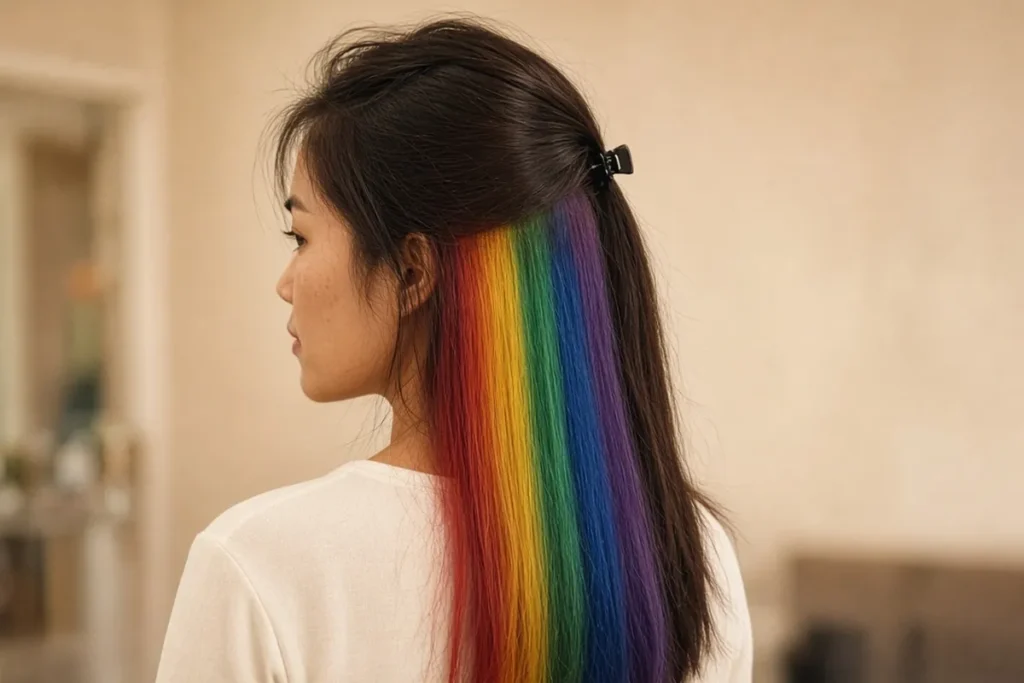
Ask for separate red, orange, yellow, green, blue, and violet ribbons underneath a natural-looking top layer. The stripes should travel downward through the hidden section rather than crossing into one muddy block. A back photograph with the top hair lifted is the useful reference.
Consider the thickness of your hair. A very deep hidden section may show around your shoulders even when your hair is loose, while a narrow one may disappear in thick waves. Ask the colorist to mark the section before any lightener goes on.
Small nape rainbow panel
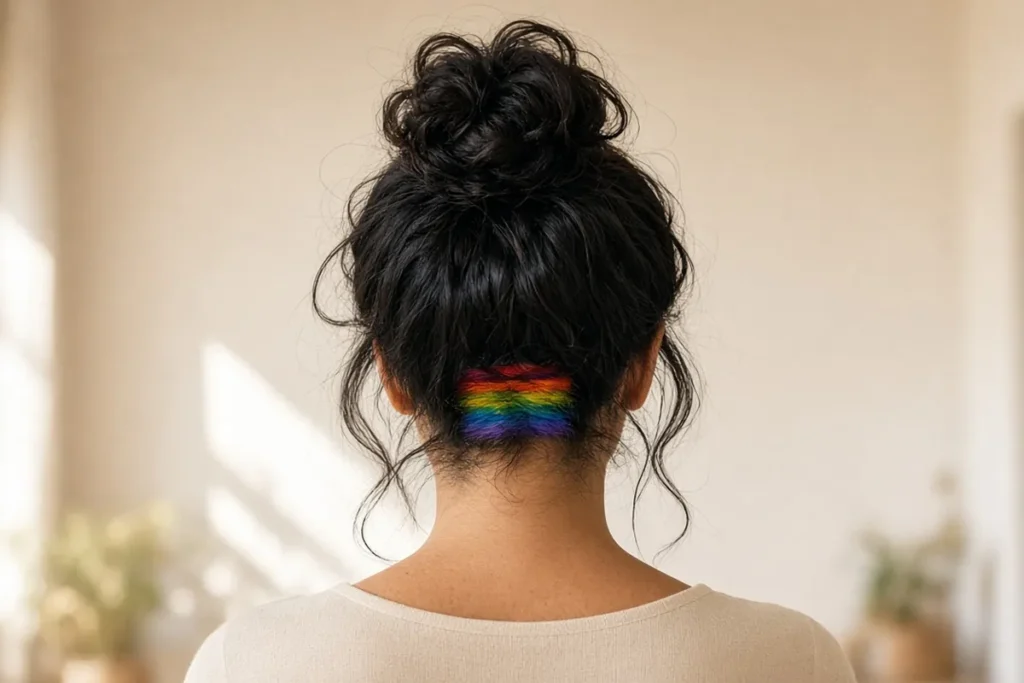
Keep the color in a compact rectangle above the neckline. It will be visible when the hair is gathered high but may remain covered when worn loose. Ask for a back view of the nape, especially if your cut has short layers that could reveal the panel unexpectedly.
You can choose brighter stripes without coloring the entire head. The area may be small, but precise sectioning still matters; adjacent shades need to stay recognizable after rinsing and styling.
Rainbow stripes behind one ear
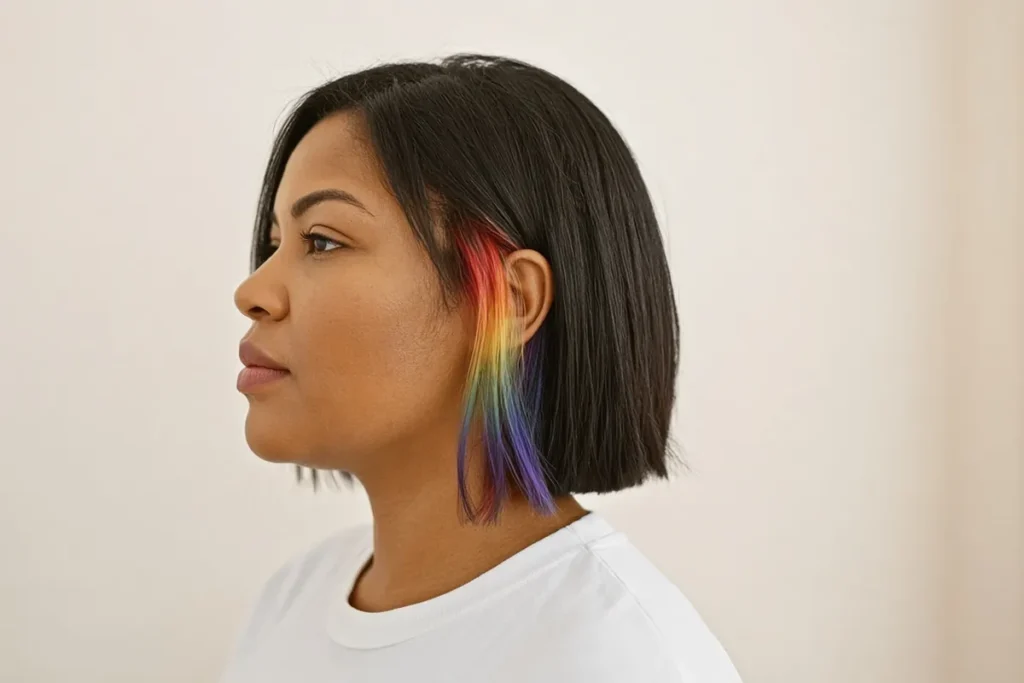
Place narrow colored ribbons behind a single ear, leaving the opposite side untouched. You can decide how much to reveal by changing your part or tucking the hair. A photograph from the colored side shows the result more clearly than a straight-on portrait.
Our peekaboo hair placement guide explains how a hidden section changes with styling. Use that idea to decide if one ear is enough or if you want the same design on both sides.
Rainbow accents around the face and ends

Partial placements can make vivid color obvious without changing every strand. The trade-off is visibility: front pieces and tips are difficult to hide. If you like a bold accent but want your natural roots, discuss where the color should stop.
Rainbow money pieces
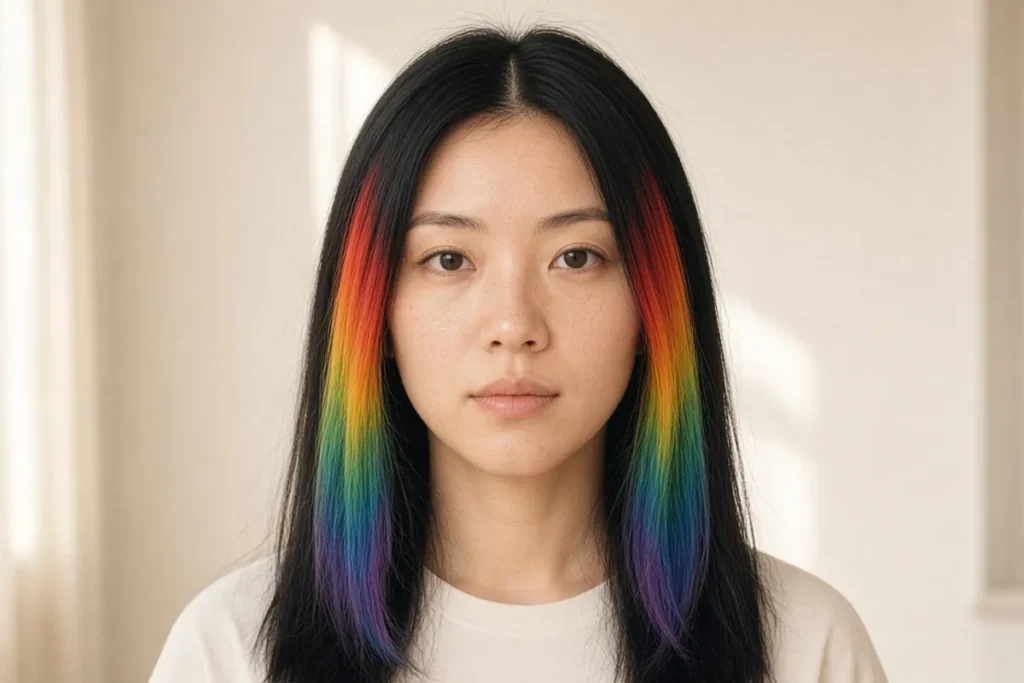
Choose two face-framing sections and arrange several shades through each section. The color can follow the full length of the strands or move gradually from one shade into another. Ask the stylist to show you the width while the hair is dry and sitting in its usual part.
The front sections are what you see every time you look in the mirror. A narrow placement is enough if you’re testing the idea. A thick block produces a different outline and may take over the rest of the hairstyle.
Prism-colored bangs
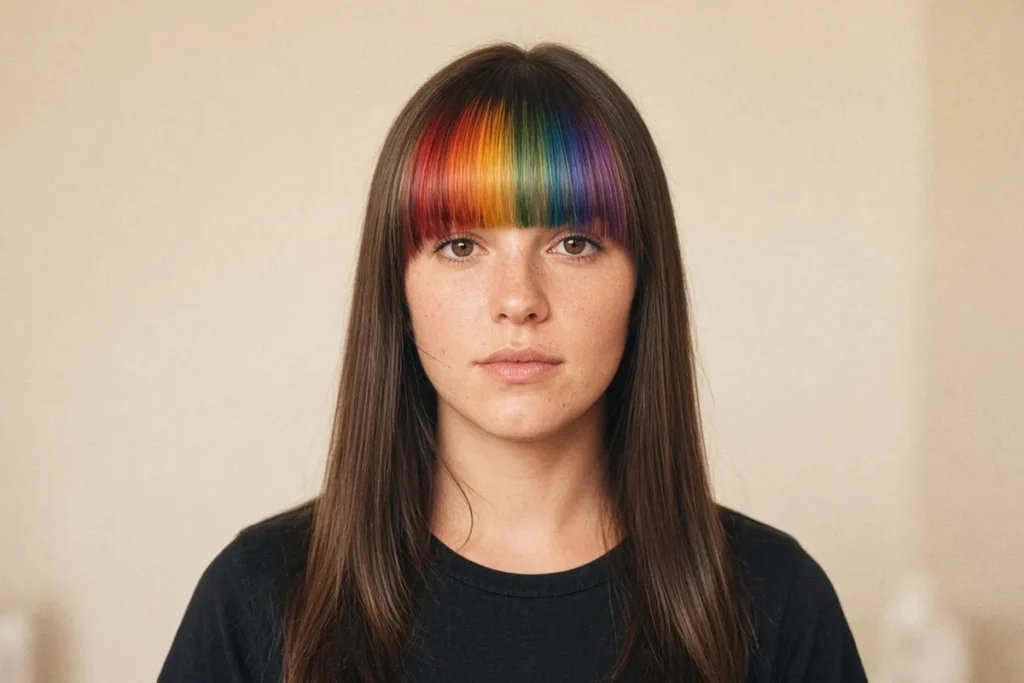
Use the fringe as the color placement, with each shade occupying a slender vertical section. Straight-across bangs show sharp color boundaries, while longer swept bangs can mix the colors visually as the hair moves. Make sure the fringe is cut to the intended shape before finalizing stripe widths.
If you’re still choosing a fringe, compare styles in our bangs guide first. You want a shape that suits your daily styling, not a cut chosen only because it makes a bright color photograph.
Rainbow dip-dyed ends

Keep the roots and most of the lengths as they are, then place bright shades through the last section of hair. Decide whether each color gets its own vertical tip or whether the ends transition horizontally. Those are separate designs, and the colorist should know which one you’re asking for.
Before lightening, discuss how much length you may cut at your next trim. If you like to keep your ends fresh, a broad colored band might disappear sooner than you expect. A smaller dip-dyed section can make the exit plan clearer.
Full-head rainbow looks that show every shade
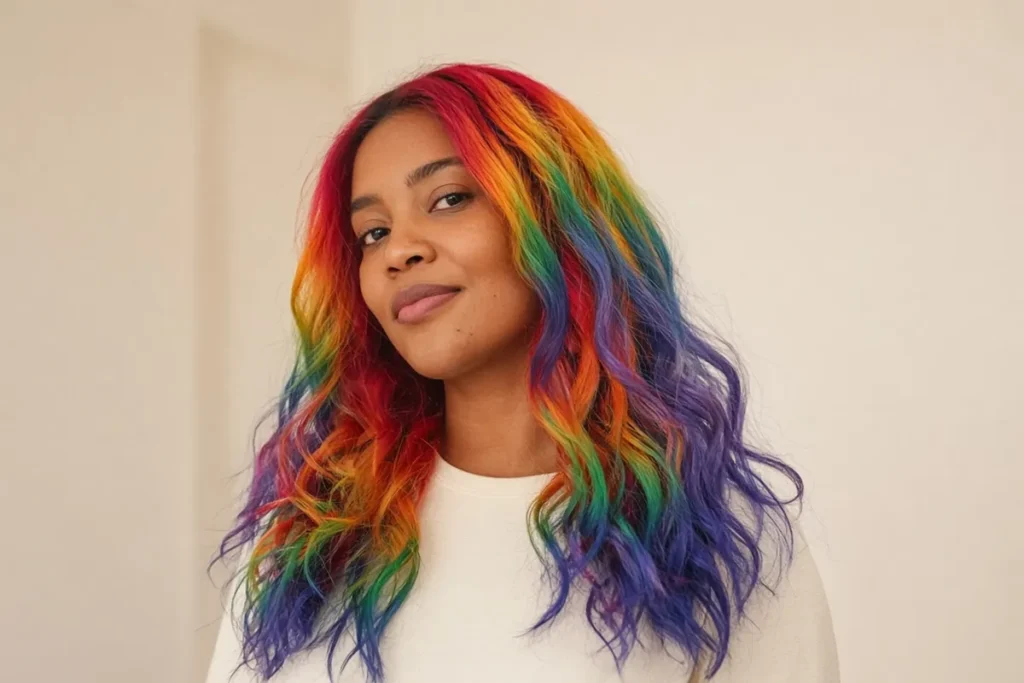
Full-head designs put color across the visible crown and lengths. They can be striking, but they also make the starting shade, root growth, and color placement more noticeable. Decide whether you prefer defined boundaries or gentle transitions before the coloring appointment.
Vertical prism stripes
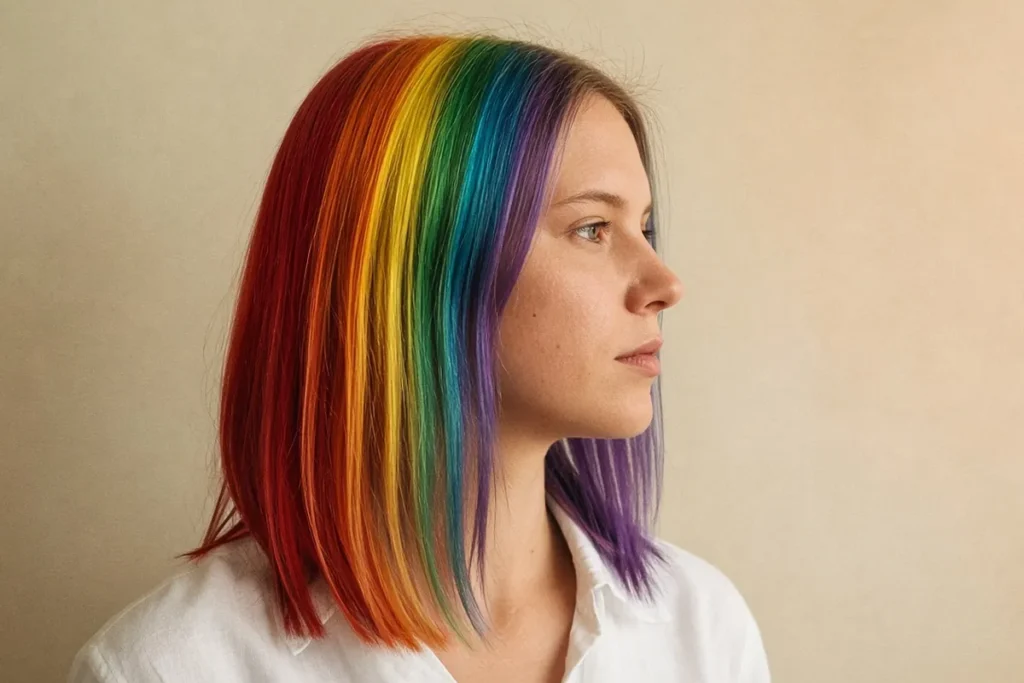
Arrange several saturated colors in tall columns from the part down the lengths. Each stripe should remain distinct when the hair is straight, with the sections placed so they stay visible from the front and back. This is the version to request if you like a clear multicolor pattern.
Bring a photograph taken in daylight. Strong filters can make similar purple and blue tones seem more separated than they would be in an ordinary room. The stylist needs to see the contrast you actually expect.
Horizontal rainbow color melt

Ask for colors that change in broad bands as the eye moves from the crown toward the ends. The boundaries can be softly blended, but you should still be able to see the planned order of shades. A long, straight back view makes the transition easier to evaluate.
Be specific about which color will sit near your face. A warm red at the root creates a different impression from a cool violet at the root, even when the rest of the spectrum is identical. The order belongs in your consultation notes.
Soft pastel watercolor rainbow
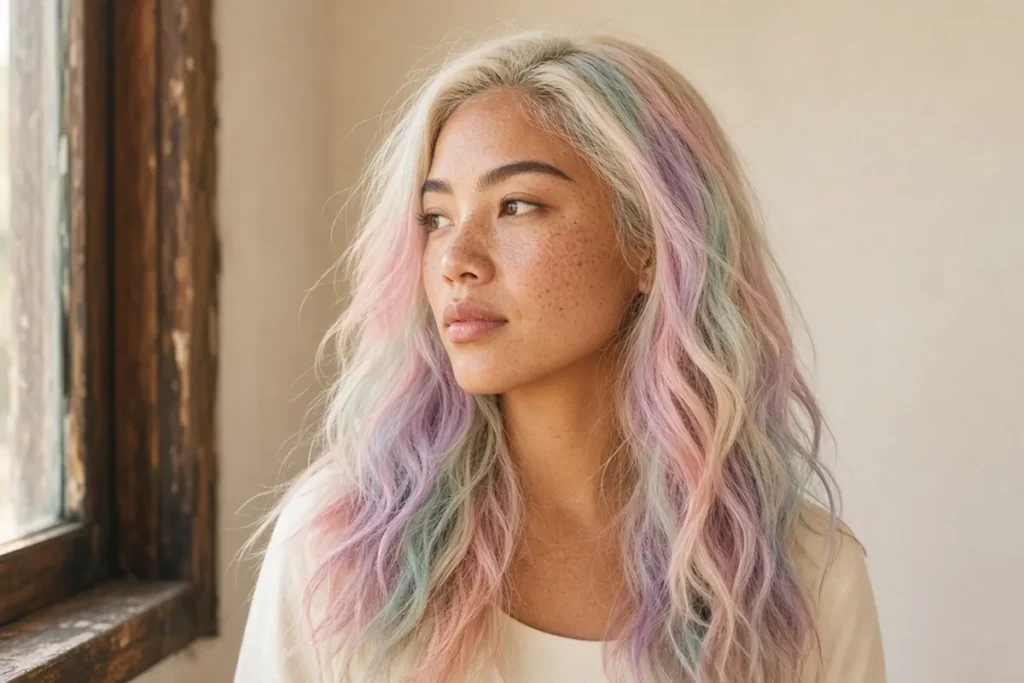
Choose diluted-looking pink, peach, lilac, mint, and blue over a suitably light base. Rather than hard stripes, the colors appear as soft sections that overlap slightly. Ask for photographs in normal daylight to judge whether the result is truly pastel or simply a faded-looking vivid color.
Pastels depend heavily on the underlying blonde. If your hair has uneven warmth, the same pastel formula may not look uniform from root to tip. Ask your colorist to assess the lengths before promising a single-session finish.
Rainbow options on brunette or black hair

Rainbow hair on dark hair changes the planning conversation. Some deeper fashion tones can produce a subtle colored reflection on a dark base, while a vivid pastel strip may require substantial lightening in that exact section. The goal isn’t to pretend the starting color doesn’t exist.
Oil-slick jewel colors

Leave the base looking dark and add overlapping blue, violet, and teal reflections through selected lengths. In indoor light it can still appear brunette; near a window the colored sections become easier to see. This is not the same as bright primary-color stripes over very pale blonde.
Ask for two reference photographs under different light. If you expect blue to be visible in every room, say so. A subtle reflective finish and a vivid colored finish are not the same promise, even if both are called oil-slick.
Deep rainbow balayage panels

Keep a brunette root and place pre-lightened areas through the middle and lower lengths, then color those sections in different jewel tones. The transition should look deliberate without pretending all the hair has been lightened. A side and back view will reveal whether the placement feels balanced.
If you like multicolor separation over a natural base, compare the visual blocks in our calico hair guide. That look isn’t a rainbow by itself, but it makes the difference between separate color panels and blended highlights easier to explain.
What lightening can mean for your starting hair

The pale base in a reference photo matters. A soft yellow underneath pastel lilac may change how the final shade appears, and old permanent pigment can complicate lifting. Do not choose a bleaching plan from a picture without telling your stylist what chemical services remain on your lengths.
The American Academy of Dermatology’s coloring guidance notes that lightening hair substantially from its natural color can cause more damage than staying close to its original shade. A smaller placement may limit how much hair is lightened, but it doesn’t make the process risk-free.
Ask for a strand assessment if your hair has old box dye, previous bleach, or obvious breakage. The stylist may suggest fewer colors, a darker palette, or postponing the service. That is a useful answer when the condition of the hair doesn’t support the picture you saved.
Choosing a palette you can maintain

Before booking, decide which matters most: visibility, softness, or a long interval before another appointment. A vivid multi-shade design can gradually change with washing. Different pigments may soften differently, so a faded result won’t necessarily resemble the original photograph.
If you want less obvious regrowth, ask about leaving the roots natural. If you want an all-over pastel finish, discuss how the untreated roots will look as they appear. These are visual decisions, not a fixed calendar that works for every person.
A colorist can also show you how the shades sit beside your everyday clothing and makeup. You aren’t required to match your skin tone to a prescribed palette. Pick the colors you enjoy, then use the consultation to make them readable on your specific hair.
The most useful reference is a photograph taken after the first few washes, if you can find one. Fresh dye and worn-in dye answer different questions. Ask which shades are likely to need a refresh and what that service would involve.
What to ask at your rainbow hair appointment

Bring three references: one for placement, one for the color combination, and one for the overall brightness. Tell the colorist which photograph controls each decision. Otherwise, they may match the placement from one image and the intensity from another without realizing you wanted the opposite.
Ask for a written or clearly explained plan that covers lightening, direct dye, styling, and any later refresh. A quote for one small hidden panel shouldn’t be compared with a full-head corrective color service. The amount of previous color and the hair’s condition may change the plan.
Tell the stylist about any scalp sensitivity or previous reaction to dye. The FDA’s hair dye safety guidance recommends a patch test for each application, leaving the test area for two days, and following all instructions. A strand test for the visual result is a separate check.
Also ask where each colored section begins. A tiny face frame positioned too far back may disappear; a hidden panel placed too high may show every time your hair is down. Agree on the section lines before any chemical service begins.
Keeping the colors clear after washing

With rainbow hair, ask your colorist when to make your first wash and which cleanser suits the dyes actually used. Some shades can transfer or rinse out when fresh. Use the care instructions for your formula rather than a universal rule about waiting a specific number of hours.
Watch the direction of rinse water if you have very light shades beside darker vivid ones. Your stylist may suggest separating certain sections while rinsing. At home, avoid aggressively scrubbing the colored lengths together; focus shampoo on the scalp and handle the ends gently.
Heat and sun exposure are also worth discussing because colored, lightened lengths may need extra care. If your ends feel rough, our dry-hair mask guide can help you compare conditioning approaches without suggesting that a mask reverses bleaching damage.
If the rainbow starts to blur or a color disappears, photograph the hair in daylight before adding another dye. Tell the colorist which section changed. A targeted refresh may be a better discussion than layering a new color across every strand.
When a smaller or temporary option makes more sense

Choose a narrower colored section if you don’t want to process most of your hair, or if you need something easy to grow out. If your hair is already fragile, ask for a no-lightener alternative instead of pushing for a pastel that needs substantial lift.
Temporary colored additions can show you whether you enjoy having several shades near your face without committing your own hair to the full process. Check how the addition attaches, how much tension it puts on your hair, and whether the color transfers to clothing.
You can also wait. If you have a major haircut or another chemical service scheduled, discuss the order with your stylist before adding more processing. Choosing less color today doesn’t stop you from revisiting the idea when your starting hair is different.
Rainbow hair should be planned around the hair you have, not a photograph that leaves the preparation out of frame. You can make a small, precise placement feel intentional without coloring the entire head or treating brightness as the only measure of success.
Rainbow hair FAQs
Can I get visible rainbow colors on dark hair without bleach?
Some deep blue, violet, and teal tones may appear as reflections on dark hair. Bright pastels and sharp primary-colored stripes usually need a lighter base to show clearly. Ask your colorist to assess your starting shade and provide realistic reference pictures.
How long will the colors last?
There isn’t one reliable duration for every combination. It depends on the dye, the lightened base, washing, and the shades chosen. Ask what the finished color may look like after several washes and whether the salon offers a targeted refresh.
Is a hidden panel easier to maintain than full-head color?
It can be easier to live with because less color is visible and the top layer may conceal regrowth. The dyed section still fades, however, and any lightened hair still needs thoughtful care. Decide based on visibility and the amount of hair processed.
Can I apply several rainbow dyes myself?
Follow the directions for each product and don’t combine dye formulas contrary to their instructions. A patch test checks for reaction; a strand test previews the color. Complex sectioning or lightening from a dark base is a good reason to consult a trained colorist.
What happens if I want my natural color back?
Your options depend on which strands were lightened and what pigment remains. A hidden section may simply grow out beneath the top layers, while a full-head design can be more involved to change. Discuss the exit plan before choosing placement.